
September 2026 light vehicle production forecast

Mobility Global provides monthly updates to our global light vehicle production forecast, offering timely insights into global auto production trends.
Each month, we leverage global light vehicle production actuals, registration data, and sales data to provide the most up-to-date, short-term production forecast available.
Here's a closer look at global production data by region and our updated September production forecast.
Top takeaways for the month
The global auto industry is still managing the fallout from the Iran conflict, with higher oil prices adding inflation pressure and raising the risk of broader economic spillover.
The biggest near-term swing factor is China, where weak domestic demand is dragging forecasts down. Chinese production is holding up better than sales because exports are doing a lot of the heavy lifting, with competitively priced vehicles gaining share in multiple markets.
Overall, the latest production update is a mix of small upward tweaks in several regions, partly offset by meaningful cuts in Greater China.
September 2026 light vehicle production forecast
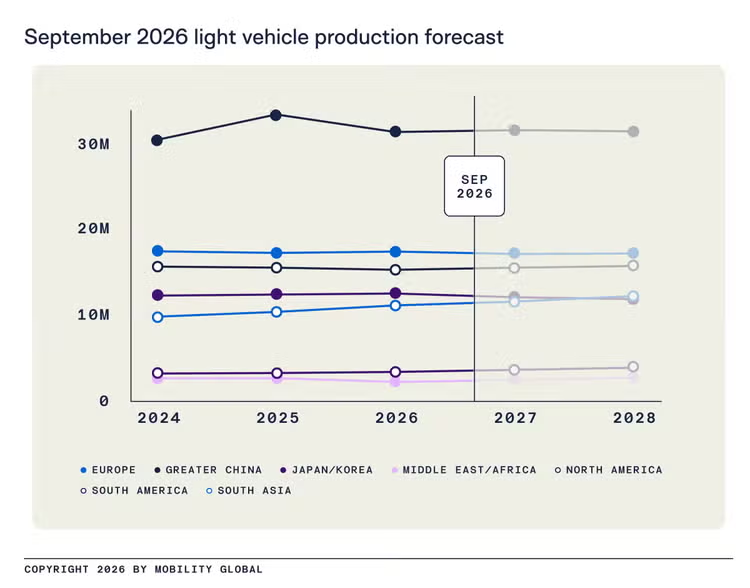
Regional highlights
Europe
Europe’s 2026 production outlook was raised by about 100,000 units. Actual results have been stronger and demand has held up better than expected. For 2027, the forecast was trimmed by about 100,000 units as Chinese imports maintain pressure on mainstream brands, especially smaller ICE passenger cars. Net: 2026 looks broadly flat, and 2027 is expected to slip by around 2%.
Greater China
Greater China production was cut by about 300,000 units for 2026 and 200,000 units for 2027, reflecting persistent weakness in domestic demand. The market is showing a clear split—retail is soft while production is steadier because exports are filling the gap. Looking ahead, exports are expected to face more friction from tariffs, investigations, tighter rules, and a gradual shift toward overseas localization.
Japan/ Korea
Japan’s production outlook was raised by about 200,000 units for 2026 and 300,000 units for 2027, supported by steady domestic demand and strong hybrid exports to North America and Europe. Over time, Japan still faces pressure from aggressive Chinese pricing and slower progress on affordable BEVs. In South Korea, strike-related disruption hasn’t changed the 2026 total much, but 2027 was nudged up by roughly 40,000 units as exports remain resilient.
Middle East/ Africa
Middle East/Africa production was increased by about 30,000 units for 2026 and 20,000 units for 2027, led by stronger near-term output in Iran and improved local demand. That said, the longer-run outlook for Iran is being treated more cautiously given the expected economic drag from the ongoing conflict. Outside Iran, growth is being helped by expanding Chinese OEM presence across Africa.
North America
North America production was reduced by roughly 50,000 units for 2026 and 70,000 units for 2027, even as US demand remains surprisingly solid. The adjustments are mainly about execution—uneven inventories, expected plant downtime, and delayed launches (including a pushout of key EV timing). Overall, 2026 production is now expected to be down about 1.6% year over year, to roughly 15.0 million units.
South America
South America production moved from flat to slightly up for 2026, as Brazil strength continues to be offset by Argentina weakness. For 2027, production was lifted by about 10,000 units, with most of the improvement concentrated in Brazil. A bigger Chinese OEM footprint is a key reason Brazil is outperforming the regional average.
South Asia
South Asia production was increased by about 200,000 units for 2026 and about 200,000 units for 2027, driven by a handful of faster-growing ASEAN markets plus continued strength in India. ASEAN growth is uneven—Indonesia, Malaysia, and Vietnam are doing most of the work, while other markets lag. India’s upgrade is backed by tax support, strong launches, and manageable inventory levels that leave room for more production.