
2027 Automotive industry outlook: How OEMs can stay competitive
Our 2027 automotive industry outlook examines global light vehicle sales forecasts, vehicle affordability challenges, EV trends and OEM priorities by region.
- Key notes for 2027
- Automotive industry analysis: What are the latest trends in car sales?
- Regional dynamics: A fragmented and asymmetric picture
- What will define competitive advantage in 2027?
- Key opportunities and risks for 2027
- Priorities for OEMs
- Frequently asked questions about the 2027 automotive industry outlook
OEM business planning for 2027 starts with one core tension: Economic uncertainty and high vehicle prices continue to suppress demand while the automotive market becomes increasingly volatile.
Today, the automotive market is entering a slower, more selective phase. For OEMs, that means a longer period of adjustment as affordability continues to shape car sales, vehicle demand, and purchasing decisions.
Key notes for 2027
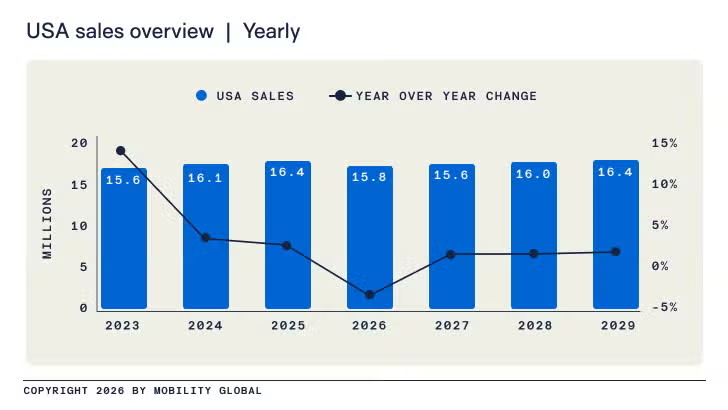
Global light vehicle sales are expected to stay subdued next year, and total industry volume (TIV) has been revised downward for 2027. Affordability remains a primary driver, next to the headwinds we currently experience on the Chinese new vehicle market.
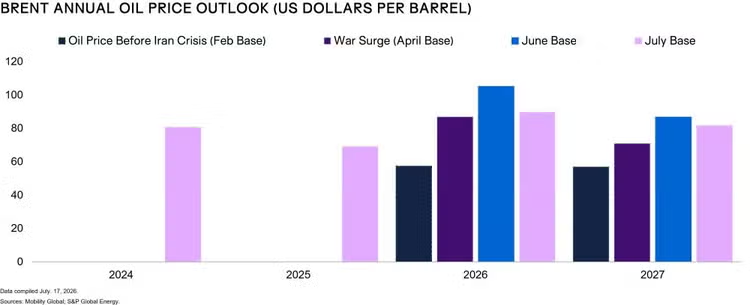
Still, the near-term macro outlook for the automotive industry has improved moderately since our previous forecast round. Lower oil price assumptions and reduced inflationary pressure are expected to ease some of the cost burden on households. These developments could slightly relax affordability constraints and support more stable demand.
That said, the forecast stance remains cautious: oil markets are still exposed to volatility and potential supply disruptions, so any demand uplift should be viewed as modest and temporary rather than a structural recovery.
Overall, the automotive market outlook continues to point to constrained volumes, with affordability remaining a key determinant of consumer purchase timing and powertrain choice.
Automotive industry analysis: What are the latest trends in car sales?
Consumers are increasingly prioritizing value, monthly affordability, and total ownership costs over vehicle size or performance. Hybrid vehicles continue to gain momentum as buyers seek a balance between fuel efficiency and purchase price, while EV adoption remains highly dependent on incentives, charging infrastructure, and vehicle affordability. These trends are shaping the automotive market outlook for 2027 and reinforcing the shift toward lower-cost vehicle offerings.
Regional dynamics: A fragmented and asymmetric picture
Which regions are leading global light vehicle sales?
Leadership in global light vehicle sales is increasingly fragmented. Market performance varies significantly by region as affordability pressures, electrification, regulation, and competitive dynamics reshape demand at different speeds. The result is a more asymmetric picture, where growth opportunities, profitability, and competitive threats differ sharply across Europe, North America, and Mainland China.
Europe:
Europe’s vehicle sales are increasingly shaped by the powertrain transition. Battery electric vehicles (BEVs) and hybrid electric vehicles (HEVs) are steadily gaining share, supported by volatile fuel prices and a broader lineup that makes electrified vehicles more accessible.
But rising EV share doesn’t automatically mean a full market rebound. Weak underlying demand, modest economic growth, and regulatory uncertainty are still capping overall car sales and keeping consumers cautious.
As a result, European OEMs are actively balancing three calls at once: the right powertrain mix, the right price points, and staying on track for CO₂ compliance. And they’re doing it while competition from Chinese imports intensifies—adding downward pressure on production, but also opening the door to smarter partnership models like joint ventures and capacity-sharing.
Looking ahead, policy initiatives and affordability-led programs can change the trajectory. By pulling investment toward smaller, lower-cost EVs, they can help close the price gap for consumers, supporting a gradual recovery in total volumes while continuing to lift EV penetration.
North America:
North America is still a core profit pool. It offers the scale and margins many OEMs need to offset pressure elsewhere. But demand is being held back by affordability. High transaction prices and elevated financing costs are stretching monthly payments for a lot of buyers.
A better oil and inflation outlook helps at the edges—but it doesn’t reset the market. The bigger reality is that competition is getting structurally tougher. More non‑US OEMs are building products specifically for US customers, raising the bar in the heart of the market.
That’s why strategies are shifting. OEMs have moved away from EV-only playbooks and toward more balanced portfolios, with renewed focus on ICE and hybrids alongside only selected EVs. And operationally, localization is becoming non-negotiable: it reduces tariff exposure and improves resilience, especially with USMCA uncertainty still in the background.
Mainland China:
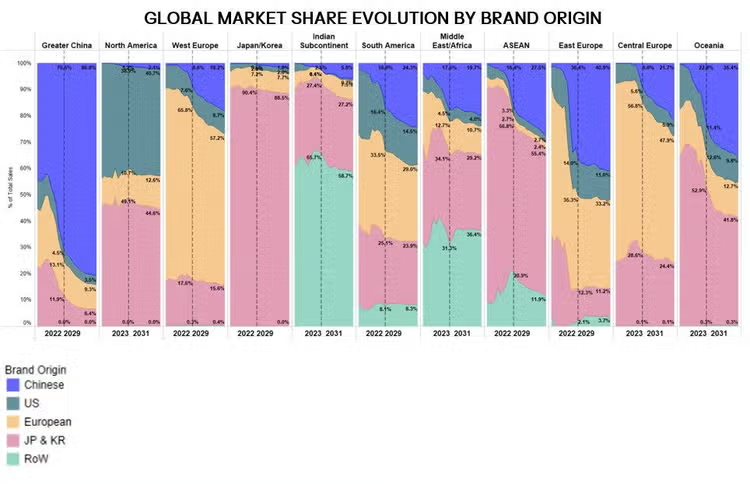
China’s auto market is under heavy short-term volume pressure as policy support fades and the macro backdrop stays soft. But the bigger story is structural: market share keeps shifting from foreign brands to domestic OEMs.
Electrification is the engine behind that shift. Local players now lead on cost, product breadth, and pace of innovation—and that advantage shows up most clearly in the segments that are growing fastest. As EV adoption accelerates, many foreign OEMs are losing relevance in key categories and giving up share quarter after quarter.
At the same time, Chinese OEMs aren’t stopping at home. They’re using their domestic scale—plus sharp pricing and, in many cases, excess capacity—to push harder into global markets. Upcoming renegotiations of long-standing joint ventures could also reset the partnership playbook inside China.
Net-net: the competitive balance is tilting. Chinese OEMs are gaining strength at home and exporting it abroad, while foreign OEMs lose ground in China. That combination raises the pressure on incumbents—and it won’t stay contained to Mainland China. It’s already spreading across Asia/Pacific and into other global markets.
What will define competitive advantage in 2027?
By 2027, competitive advantage will not be about traditional OEM rivalries, it will be about who can move faster, build cheaper, and own the parts of the stack that actually differentiate.
Speed as a product feature
Chinese OEMs are setting the pace on development velocity. Vertical integration and simplified architectures let them launch faster, refresh more often, and react to customer feedback quickly. The “so what”: speed translates directly into share gains and pricing leverage—either by staying ahead on features or by using time advantage to price harder.
Structural cost advantage (not incremental cost-out)
The leaders are redesigning the cost model itself through:
- Simplified vehicle architectures and fewer variants
- Higher vertical integration where it matters
- Development & manufacturing approaches that ramp faster and waste less
The “so what”: This creates lower unit costs that persist cycle after cycle, which is exactly what enables sustained aggressive pricing without destroying margins.
Technology control becomes a strategic choice
Technology players are getting embedded deeper into software, electronics, and compute platforms. That forces OEMs to be explicit about:
- What they truly own and differentiate (UX, ADAS stack, vehicle OS layers, data, core electronics)
- What they’re comfortable sourcing as modular components
The “so what”: If you don’t choose, the ecosystem chooses for you—and differentiation (and margin) gets competed away.
What incumbents should know
Legacy OEMs still have real advantages in Europe and North America:
- Entrenched distribution and service networks
- Brand equity that supports pricing and residuals
- Local supply chain control that can reduce disruption risk
The “so what”: The winners will be the ones who pair those legacy strengths with a modern cost base and a clear tech ownership strategy—not the ones trying to defend yesterday’s model with incremental fixes.
Key opportunities and risks for 2027
Where OEMs can win
The growing “China price deflation effect” provides opportunities to stimulate demand in selected markets, supporting TIV development under affordability constraints. Moreover, the resurgence of hybrid technologies addresses immediate consumer needs while serving as a critical bridge to sustain profitability during electrification.
A more benign oil and inflation outlook provides limited upside to near-term demand, although this should be interpreted as a mild uplift rather than a recovery. Strategic partnerships, particularly with Chinese OEMs, offer opportunities for cost efficiency, faster development cycles, and improved competitiveness.
Risk that could derail growth
While energy-related risks have moderated compared with previous forecasts, they remain relevant. Oil prices continue to carry volatility and potential supply disruption risk, which could feed back into inflation and consumer demand. In addition, the risk of semiconductor memory shortages, cost increases and potential disruption of chip supply chains around Taiwan remain high on our risk watchlist.
Consequently, affordability remains a key structural constraint despite some macro relief. In addition, geopolitical tensions, trade restrictions, and ongoing weakness in China’s domestic market continue to pose risks to global demand and supply chains. The weakness in China’s domestic market reinforces the global export push of local OEMs, intensifying pricing pressure across regions and further challenging incumbent players. In turn this is likely to raise the stakes at a political level as Governments come under even more pressure to monitor and manage auto trade imbalances and the implications for domestic employment
Priorities for OEMs
OEMs can no longer rely on incremental change.
The traditional global vehicle business model is becoming less effective. Instead, OEMs need region-specific strategies that align products, platforms, and technologies to local market needs. This shift increases complexity and makes regular reassessment of portfolios, partnerships, and production footprints more important than ever.
Key priorities include:
- Flexible drivetrain portfolios balancing ICE, hybrid, and EV powertrains, but still keeping variant complexity and thus cost under control
- Affordability-focused product development
- Dynamic pricing and portfolio steering across segments
- Localization of supply chains and production
- Strategic partnerships, including collaboration with Chinese OEMs
- Continuous structural cost reduction and simplification
OEMs may also need to reassess their geographic footprint, including potential exits from structurally challenging markets, portfolio rationalization, and increased cooperation to achieve scale advantages.
The 2027 automotive market will be defined by constrained demand, affordability pressures and intensifying competition. While macro conditions have improved at the margin due to lower oil prices and moderated inflation, this does not fundamentally alter the broader structural challenges.
Success will depend less on scale alone and more on competitive cost structures and clear regional strategies.
Frequently asked questions about the 2027 automotive industry outlook
Several factors are shaping car affordability across the global automotive market. Higher vehicle prices, financing costs, insurance expenses, regulatory requirements, and slower household income growth are all putting pressure on household budgets.
As a result, affordability has become one of the most important drivers of vehicle demand, purchase timing, and powertrain choice. This remains a defining theme in our automotive industry analysis and broader automotive market outlook.
OEMs should adopt a scenario-planning approach that tests strategies against multiple potential outcomes. This helps decision-makers understand how different combinations of market, technology, regulatory, and economic conditions could affect vehicle demand, powertrain mix, production footprints, pricing strategies, and investment priorities.
Rather than asking, "What will happen?", leading OEMs are increasingly asking, "What could happen and how prepared are we?" This approach can improve resilience, reduce risk, and help organizations make faster decisions when market conditions change.
To explore this topic further, see our:
- Scenario Planning Insights hub for the latest forecasts and planning perspectives.
- How OEMs Can Use Scenario Planning to Navigate Uncertainty for practical guidance on building uncertainty into strategic planning.
- Mastering the "What Ifs": Scenario Planning for Resilience and Agility for a deeper look at how scenario planning can strengthen long-term decision-making.
- Automotive Scenario Planning Advisory Services to learn how we help OEMs evaluate risks, identify opportunities, and develop robust strategies for an uncertain future.