
Europe's EV battery supply chain faces new reality after Hungary's Semcorp shutdown
Hungary's shutdown of Semcorp's battery plant highlights growing regulatory risks across Europe's EV battery supply chain.
In late June and early July, the Hungarian government ordered a complete shutdown of Semcorp’s lithium-ion battery separator plant in Debrecen over environmental violations, including abnormal groundwater contamination. Fire-safety concerns further escalated the case, turning a regulatory dispute into a broader test of industrial oversight.
The issue has expanded beyond Semcorp. The Hungarian government has announced plans to create a new top-level authority to monitor and sanction polluting industries as part of a broader effort to tighten regulation of the EV battery sector.
Hungary’s action against mainland China-based Semcorp highlights a tougher phase in Europe’s battery industry, where regulatory compliance, pollution controls, and community acceptance are becoming critical factors in investment decisions. Semcorp, a major producer of battery separator films, plays an important role in Europe’s EV supply chain through its Debrecen facility, operational since 2023. Any prolonged disruption could affect battery manufacturing networks linked to Chinese investments across Europe.
Hungary matters because it sits at the center of Europe's EV battery supply chain
The country has become one of Europe’s most important hubs for EV battery manufacturing, battery cell production and energy storage investment. Major manufacturers have committed billions of euros to facilities designed to support long-term EV growth across Europe. But the Semcorp case shows how quickly that strategy can be tested when industrial ambition collides with environmental compliance.
The Semcorp suspension can be viewed as one of the earliest and most visible manifestations of Hungary’s political transition following the defeat of Viktor Orbán’s Fidesz government earlier in 2026. Under Orbán's government, Hungary aggressively pursued its ambition of becoming Europe's leading battery manufacturing hub, attracting major Asian investors such as Samsung SDI and Semcorp through subsidies, regulatory support and fast-tracked industrial development.
However, as battery production expanded, so did environmental and community concerns. At Samsung SDI's Göd facility, complaints shifted from noise, traffic and industrial emissions in 2018-2019 to allegations of particulate pollution, groundwater contamination, repeated incidents of worker exposure and legal challenges to environmental permits between 2020 and 2025. The designation of Göd as a special economic zone further fueled perceptions that local oversight was being weakened in favor of industrial growth.
By the time Péter Magyar's government took office in 2026, concerns had emerged that economic priorities were outweighing environmental accountability. The Semcorp case quickly became a symbol of that debate.
The new government came to power on a platform emphasizing transparency, accountability, and the restoration of institutional checks and balances. Against this backdrop, the decision to suspend Semcorp’s Debrecen operations signals a departure from the permissive regulatory culture that characterized Hungary’s battery boom.
The implications extend beyond Hungary. The country anchors a large share of Europe's battery production and hosts major investments across the EV battery supply chain.
According to Mobility Global, Hungary accounted for nearly 46% of total cells produced for the light-vehicle segment in 2025. Despite other countries also gaining speed in battery localization, Hungary is expected to maintain a share of around 40% in 2035, with the supply increasing from 45 GWh in 2025 to nearly 235 GWh in 2035.
The broader EV battery supply chain also depends on reliable access to critical raw materials, including lithium, nickel, cobalt and graphite, which remain essential for battery production and long-term industry growth.
Installed Li-ion battery manufacturing capacity in Europe, 2024 - 2031
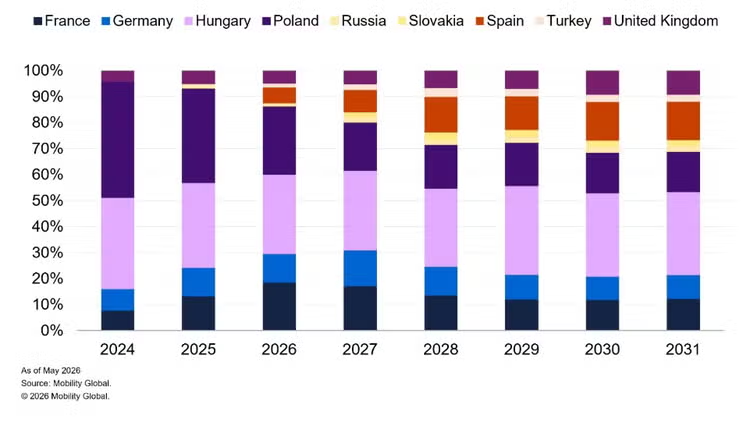
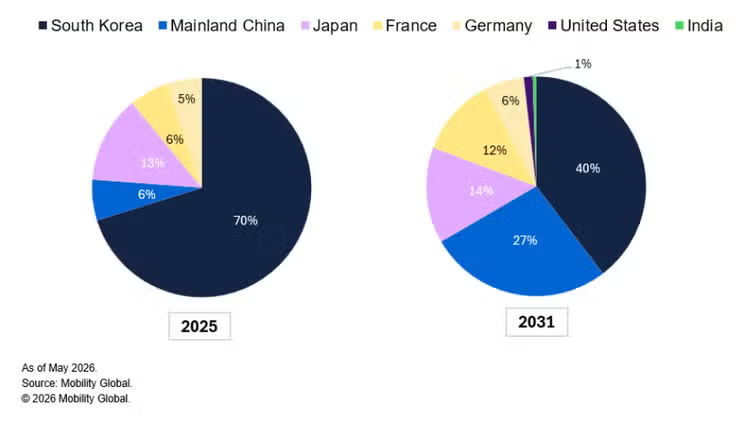
Hungary's largest operating battery plants belong to South Korean cell makers, Samsung SDI and SK On. The country's biggest upcoming project is CATL's new facility, scheduled to begin battery production later this year, while EVE Energy plans to launch production from its Hungarian gigafactory in 2027.
If authorities expand their crackdown on the EV battery industry, these new projects can expect some strong headwinds.
China's role in the lithium-ion battery market
The Semcorp case also highlights Europe's continued reliance on Chinese battery technologies, capital and supply networks. Many of Europe’s battery investments have come from mainland Chinese firms or have involved mainland Chinese technology and capital. As a result, projects linked to Chinese companies often attract greater political and regulatory scrutiny than comparable investments from other regions.
According to the Bank of Finland Institute for Emerging Economies (BOFIT), in Europe, the automotive sector remained the primary destination for mainland Chinese investors, accounting for approximately €7.6 billion, or 45% of total FDI in 2025 (52% in 2024). Around 93% of this automotive-related investment in 2025 went toward EV value chains, particularly battery production.
Within Europe, Hungary attracts the highest levels of FDI from mainland China. According to the Mercator Institute for China Studies (MERICS), Hungary attracted mainland Chinese investment worth €3.9 billion in 2025, higher than the €2.5 billion in Germany and the €1.9 billion in France. MERICS reported that mainland Chinese investment in Europe rose 67% year over year in 2025 to a seven-year high.
Although mainland China is not Europe’s largest source of FDI, its investment inflows remain substantial and will be hard to ignore.
When a Chinese battery supplier is linked to environmental concerns, the impact can extend well beyond a single project. Cases such as Semcorp can shape public attitudes toward foreign industrial investment and intensify debate over whether Europe is trading strategic autonomy for a new form of dependence. As a result, the company's troubles may influence how welcoming other European governments become toward future Chinese battery-sector investments.
Capacity in Europe by cell maker's nationality
Which European countries could benefit if Hungary loses momentum?
Germany and France are the two other countries that already have a sizable EV battery manufacturing operation and are expected to continue to expand their capacity over the next five years.
France is home to Envision AESC’s gigafactory in Douai, Automotive Cells Co.’s and Verkor’s plant in Dunkirk. Completed in December 2025, Verkor’s 16-GWh plant is the most recent and is expected to start supplying Renault this year. Prologium Technologies is also constructing a new solid-state plant in Dunkirk, which is expected to be completed by 2029, but deliveries are not expected to start before 2032.
Together, these projects are positioning France as one of the clearest alternatives to Hungary's battery expansion model. If regulatory uncertainty slows growth in Hungary, France could attract additional EV battery manufacturing projects and strengthen its position within the European battery supply chain.
Germany has a 14-GWh CATL plant in Arnstadt and a 40-GWh (when fully operational) plant in Salzgitter. Tesla, too, is slowly moving toward producing cells at its Berlin gigafactory and could reach about 12 GWh by 2031.
Spain has been one of Europe's most active markets for battery investment. The government recently committed €138 million in support of Gotion's €940 million battery-materials project in Valladolid, while Hunan Yuneng plans to invest €800 million in a cathode-material plant in Mérida to support lithium iron phosphate (LFP) battery production. PowerCo and Envision AESC are also expanding Spain's manufacturing footprint, with combined capacity expected to reach 70 GWh by 2031.
Yet Spain's openness is not unconditional. Policymakers increasingly want Chinese investment to deliver more than capital expenditure, including local jobs, technology transfer and deeper integration into the European battery supply chain.
Together with France and Germany, Spain's growing battery ecosystem provides manufacturers with alternatives as they seek to diversify production and investment across Europe.
What the Semcorp shutdown means for Europe's EV battery production in Europe
The Semcorp shutdown is an early test of Europe's next phase of battery growth. For years, success was measured by investment announcements, factory construction and production targets. Today, environmental compliance and community accountability carry equal weight.
Europe still needs Chinese capital, technologies and manufacturing expertise to meet its battery ambitions. But investors now face tougher expectations. Companies that combine scale, compliance and local trust will be best positioned to succeed. Hungary is where that new reality is being tested first, with implications for EV battery manufacturing, energy storage deployment and future battery investment across Europe.
Build future-ready EV strategies
Our E-Mobility Technology Module helps you take the guesswork out of EV planning with the industry's most advanced EV data, deep technology and sales insights to power confident product and market decisions.
Combine granular vehicle specifications including performance, range, dimensions and payload with forward‑looking technology trends like battery innovation, charging behavior, and electric power to anticipate how vehicles will evolve and align product strategies to real market demand, reducing risk and ensuring new models meet future customer expectations.