
Expansion of EV charging
infrastructure slows
as EV demand moderates

Is EV charging infrastructure losing steam? Explore the latest forecasts, policy shifts and global trends redefining the road to electrification.
Slower electric vehicle adoption shifts EV charging infrastructure forecast
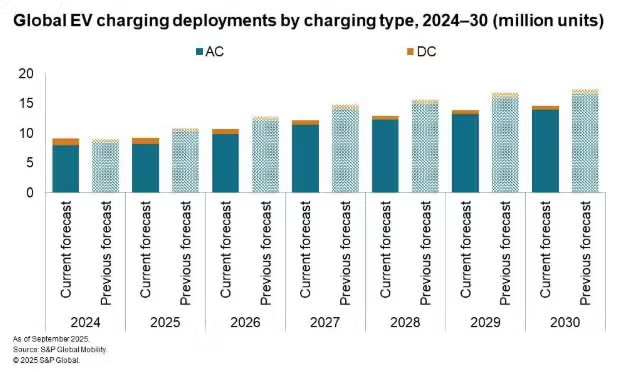
Slower EV adoption has delayed charging station expansion plans for many networks, shifting the focus from rapid deployment to optimizing existing assets. In S&P Global Mobility’s latest forecast, we expect the number of annual EV charging station installations throughout this decade—especially in the public/semi-public domain—to be 8-10% lower than the 2024 forecast.
This will also reduce the cumulative number of EV charging stations over time. We now expect that in 2030, the number of chargers in operation in the public/semi-public domain globally will be around 18.4 million, compared with the 20 million we forecast in 2024.
Global EV charging solutions face headwinds
The global EV charging infrastructure market is characterized by significant regional variations in deployment and adoption rates. Trends differ across regions due to local policies, consumer preferences and technological advancements. Most regions, including Europe, Japan/Korea and North America, have seen a slowdown in installations of EV charging points.
For example, in North America, S&P Global Mobility now expects around 120,000 EV chargers to be installed in the public/semi-public domain in 2025, down from the more than 160,000 chargers estimated in the 2024 forecast. Annual installations are expected to be lower throughout the decade.
This change mirrors our revised plug-in electric vehicle (PHEV) production forecast. Compared with November 2024 data, we have reduced the 2030 forecast for battery electric vehicles (BEVs) and PHEVs by 18.3% and 6.5%, respectively, in the October 2025 update.
Although Europe’s estimates remain lower than in 2024, the reductions are not as sharp as in other regions, especially Japan/Korea. South Korea has experienced one of the steepest drops in annual installations of EV charging stations compared with last year, driven primarily by the 2024 BEV sales decline and reductions in EV subsidies, which have weakened consumer confidence in BEVs.
We now see an increasing interest in hybrid vehicles, which have shown remarkable growth. Sales have rebounded in recent months and are expected to see year-over-year growth in 2025. Government authorities are also reportedly considering restoring higher EV incentives to support this turnaround.
The role of policy in developing EV charging infrastructure
Policy frameworks also play a crucial role in shaping the EV charging infrastructure landscape. Significant regulatory developments in some markets, including the European Union's Alternative Fuels Infrastructure Regulation and the United States' National Electric Vehicle Infrastructure (NEVI) program, set ambitious targets for charger deployment and emphasize transparency, consumer protection and grid integration.
However, uncertainty due to US policy reversals has impacted industry confidence and investment. Recent policy shifts under the Trump administration(opens in a new tab) have led to changes in the NEVI program, with the emphasis now on granting states more autonomy to allocate funding and reduce regulatory burdens to accelerate EV charging infrastructure deployment.
The US has also now removed the $7,500 tax credit for purchasing new EVs, which is almost certain to further put pressure on EV sales.
China and South Asia sustain momentum in EV charging solutions
The two regions that have succeeded in maintaining a positive outlook for EV charger deployment are Greater China and South Asia. The forecast for annual EV charging installations in Greater China has risen marginally for all years of the forecasting period. In 2030, we expect Greater China to have nearly 12.3 million cumulative charging stations installed, compared with the 12.2 million units forecast in the 2024 update.
In Mainland China, the vehicle-per-DC charger ratio, which takes into account BEV and PHEV numbers, is also relatively low, indicating a well-developed charging network. However, this ratio is expected to increase modestly from 14 EVs per charger in 2024 to 17 EVs per charger in 2030. By comparison, the same ratio in the US was 159 EVs per charger in 2024.
However, most countries will struggle to keep pace with EV adoption rates(opens in a new tab), and we expect the vehicle-per-charger ratio to worsen by the end of the decade. For example, in the US, this ratio is expected to drop to 1:200, and in Japan the ratio is expected to change from 1:44 to 1:98.
Navigating the future of EV charging points
The EV charging infrastructure market is navigating a complex landscape shaped by slowing EV adoption rates and the resulting pressures on investment and expansion. As EV sales moderates, investors and developers are taking a more cautious approach, reassessing timelines and investments for EV charging solution expansions. This shift from rapid deployment to optimizing existing assets underscores a strategic pivot toward enhancing efficiency(opens in a new tab) in the face of moderated demand growth.
The downward revision in expected annual EV charging point installations, particularly in the public and semi-public domains, reflects a recalibration of market expectations. The projected reduction in cumulative charger installations by 2030, as per S&P Global Mobility’s EV charging infrastructure forecast, underscores the need for a more measured approach to EV charging infrastructure development. This recalibration varies across regions, with Greater China and South Asia maintaining a relatively positive outlook, buoyed by supportive policy frameworks and a robust commitment to EV adoption.
The path forward requires coordinated efforts to address regional disparities, boost consumer confidence and foster a supportive environment for the ongoing transition to electric mobility. As the industry adapts, strategic investments, technological innovation and consumer-focused EV charging solutions will be crucial in shaping the future of the EV charging infrastructure landscape.