
Ford and Geely plan a new European joint venture at Valencia. Discover the impact on production, EV strategy, costs, and future growth.
The Mobility Global AutoIntelligence service provides daily analysis of global automotive news and events. We deliver timely context and impactful analysis for navigating the fast-moving industry. Behind the Headlines offers a bi-weekly dive into recent top stories.
Last week, Ford Motor Company and Geely Automobile Holdings announced plans for a new joint venture (JV). If successful, the plan may secure the future of Ford’s Valencia, Spain, production site and enhance the pair’s presence in Europe.
Proposed deal could see five vehicles produced at Valencia
The proposed JV centers on Ford’s underutilized Valencia complex, where products and headcount have been whittled back over the past decade. Production peaked at 419,300 units in 2017, when Ford produced five products there. By 2025, Ford had dropped four of them, leaving only the Kuga. Mobility Global currently forecasts that production at the facility will fall to only 85,500 units in 2026, less than 20% of the site’s potential 500,000-unit capacity.
Pending regulatory approval, the JV plans to begin operations during the first half of 2027, with its first new vehicle produced in 2028. Ford plans to build a new European-specific member of the Bronco sport-utility vehicle (SUV) family at Valencia in 2028. Mobility Global forecasts the European Bronco will use the Ford-developed C2/GE1 platform that underpins the current Kuga.
Through the JV, Ford also plans to produce two all-new multi-energy compact crossovers based on the Chinese automaker’s GEA platform. One is expected to replace today’s Kuga, while the other will expand Ford’s lineup. The door is open for hybrid, plug-in hybrid or electric vehicle options from the multi-energy platform, and Ford has not yet commented on which it will choose.
Geely said it will build two “sleek electric SUVs” to support its European growth strategy. Geely Senior Vice President Victor Yang told Reuters that one will be the E5/EX5, which is already sold in Europe, while the second remains in development. The JV is scheduled to start production of the first shared-platform Geely and Ford products during 2028.
The plans call for four utility vehicles in roughly the same size class, raising concerns about potential product overlap. Ford executives, however, said the company will design its own distinct products. As Jim Baumbick, president of Ford of Europe, told Automotive News Europe, “We are going after a very targeted area. The goal is not to have overlapping products. You will see a very focused passenger vehicle portfolio around the rally-bred adventure, thrill space. There will be no benefit from us trying to eat each other’s lunch. The Ford product will be a completely unique top hat.”
Production forecast to favor Ford products
Output at Valencia should recover quickly once these new products come online. Mobility Global forecasts that production will peak at 332,150 units during 2030—with the new European Bronco accounting for more than 52% of output. The remaining volume will be split among the four products using the Geely-developed platform.
The partnership differs from Ford’s existing European collaborations with Volkswagen and Renault. Those projects are transactional and do not involve shared ownership of a manufacturing facility. Ford is able to produce EVs using the VW platform, for example, while Renault will make EVs for Ford. In the Ford–Geely JV, by contrast, Ford will have 66% ownership and Geely 34%.
The JV has the potential to make better use of Valencia’s capacity. As Baumbick told Automotive News Europe, “Our goal is to completely load this plant up to maximum capacity.” By doing so, according to Ford’s press release, it will be able to lower the cost of every vehicle built there. The JV will also allow Ford to leverage Geely’s lower development costs for the shared-platform projects.
Lower costs are critical to Ford. As Baumbick said, “The environment in Europe has changed forever. It’s at a new level of cost…What we are trying to do is ensure the lowest possible cost while building products specifically in Europe for European customers.” His comments also underscore automotive industry trends to shift away from global products toward more regionally developed offerings.
For Geely, the deal represents a cost-effective path to establishing a production footprint in Europe, similar to deals it has struck elsewhere. Although the Chinese automaker already has a European presence through Volvo Cars and Lotus—and could look to Volvo’s Ghent plant for contract manufacturing—it has not yet localized production of any of its Chinese-originating brands in Europe.
Geely will also avoid a 28.8% European tariff imposed on its EVs imported from China while establishing European production at a far lower cost than building its own plant.
More efficient use of capacity may benefit sales
The agreement could strengthen Ford’s competitiveness in Western and Central Europe, where its passenger-car sales have struggled recently, falling 51% from 1.03 million units in 2019 to 494,800 units in 2025. The market has struggled overall as well, falling by 16% over the same period.
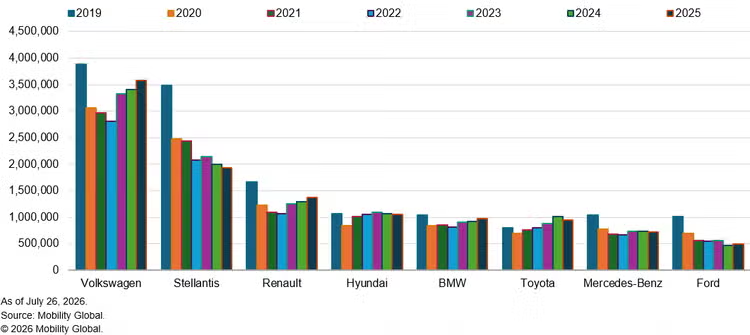
Regulatory changes have affected the region, and most legacy automakers remain below their 2019 sales levels. Ford also slimmed down its lineup and made some strategic missteps. Those challenges are now compounded by Chinese newcomers competing on technology and price despite the European Union’s efforts to support its local automotive industry.
A meaningful recovery is still several years away, with new products not arriving until 2028 or later. Mobility Global forecasts that Ford sales in this region will drop again in 2026 and 2027, but the upcoming products will help the company’s sales grow to 493,500 units in 2029. That would return sales to roughly their 2025 level, yet still represent less than half of Ford’s 2019 passenger-car volume.
The agreement also creates an opportunity for Geely to grow its brand in Europe. We forecast Geely sales will grow from 36,300 units in 2026 to 87,600 units in 2030. However, because the brand had no real presence in this region until 2025, this forecast could evolve once consumer acceptance and product plans become clearer.
Creative, targeted partnerships offer hope for European manufacturing
Ford is the latest in a string of European vehicle producers to make deals with Chinese automakers. These agreements give Chinese automakers access to underutilized European manufacturing capacity, supporting their regional growth ambitions. For legacy automakers, these agreements creatively address the overcapacity issues that have plagued the European automotive industry for decades. Building new plants is more expensive and only adds to existing overcapacity.
Yet the agreements also contribute to the downward pricing and cost pressures facing the legacy industry in the region. Concerns remain over the inherent cost advantages of Chinese-developed vehicles. Although localized production requires investment in the European supply chain and manufacturing capacity, some cost advantage will transfer. As a result, these agreements may not fully resolve long-term concerns over the health of legacy automakers or the ownership of Europe’s manufacturing base.