
Ford Maverick finds success in a segment all its own
Explore how the Ford Maverick created a new pickup segment, attracting buyers from rivals with strong sales, high conquest rates and hybrid appeal:
Since its launch in 2021, the Ford Maverick has carved out a distinctive position in the US pickup market, combining strong sales and customer conquest rates with little direct competition.
Before its arrival, the compact pickup segment did not exist—the smallest pickups on the road were midsize pickups like the Toyota Tacoma and Nissan Frontier. Moreover, the Maverick is the only “functional” model in its segment: the only other small pickup is the Hyundai Santa Cruz, a lifestyle-oriented vehicle that offers less of the traditional utility associated with pickup trucks.
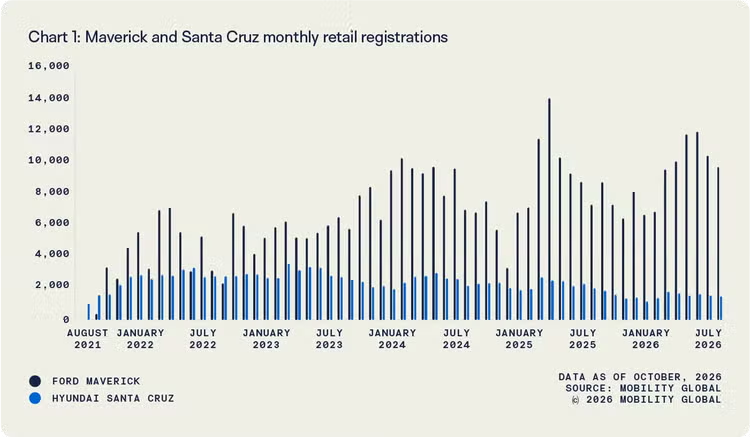
Mobility Global registration and loyalty data show that the Maverick has performed well. Monthly retail volume grew quickly in 2022 and has reached new highs since 2024, surpassing 8,000 units in 13 of the past 18 months, as demonstrated by Chart 1 below showing Maverick and Santa Cruz monthly retail registrations. Because the Santa Cruz serves a different purpose, the Maverick has no directly comparable competitor against which to measure its performance.
Maverick maintains unusually strong conquest rates
The Maverick also consistently has attracted more customers from competing brands than it has lost to them. Its initial conquest-to-defection ratio of 43 in January 2022 was unsurprising, given that defections would have been minimal so soon after its introduction. More notable is the model’s ongoing sustained performance on this metric. The Maverick’s ratio has remained above 1.0 every month, indicating a net inflow of customers, and has exceeded 2.0 in all but one month, highlighted in chart 2 showing Maverick C/D ratio. Maintaining such a strong ratio for more than four years is unusual—and impressive.
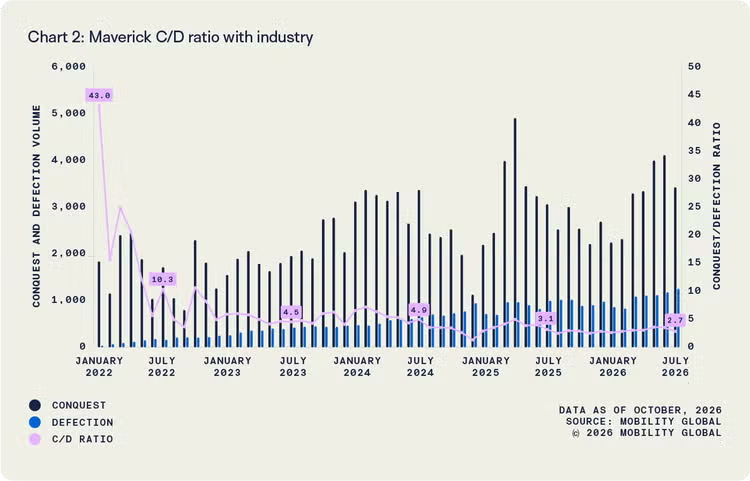
The Maverick’s ratio has also consistently been higher than the Ford brand ratio, which stood at 1.06 in 2021 but had declined to .95 by August 2026.
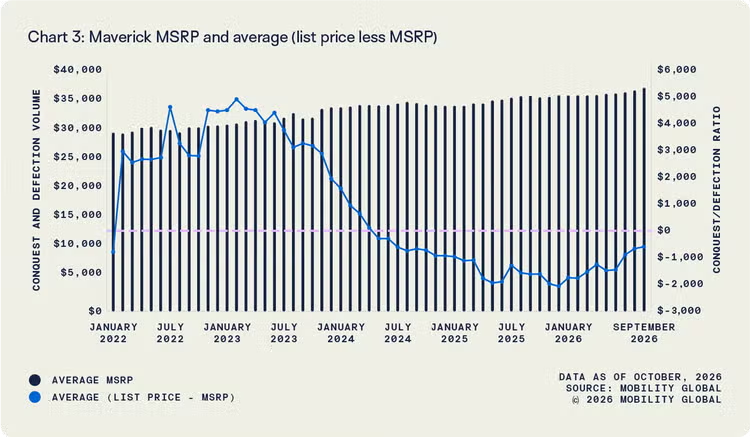
Ongoing robust retail demand for the Maverick relative to supply is also reflected in its MSRP and advertised prices. From February 2022 through April 2024, the Maverick consistently was advertised at a price higher than MSRP (see in the chart below highlighting Maverick MSRP and average list prices). This gap between list price and MSRP peaked at $4,895 in February 2023 before declining. As supply overtook demand in 2024, the Maverick’s list price dropped below its MSRP in May and has remained there ever since.
Prices climb as inventory levels grow
Although the Maverick’s MSRP was relatively low when it first hit dealer lots, it was far from the lowest in the industry. In January 2022, 32 models had MSRPs below the Maverick’s $29,531.
By September 2026, the Maverick’s MSRP had risen 25% to $37,000, outpacing the industry-wide increase of 16% during the same time period. Despite this faster price growth, the Maverick’s relative position in the market has changed little: 35 models now have lower price points.
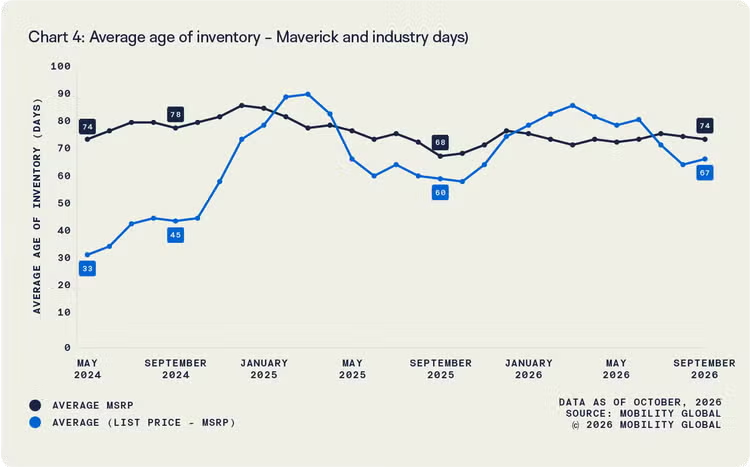
As the Maverick’s supply has grown relative to retail demand, inventory levels have improved. Back in May 2024, the average age of Maverick inventory was just 33 days, compared with the industry average of 74 days. Since then, that figure has climbed to 67 days, approaching the industry’s average.

Sustaining the Maverick’s competitive advantage
The Maverick has been a successful incremental model in Ford’s portfolio, attracting new customers and generating sustained sales growth. Although its profitability is beyond the scope of this analysis, it remains an important consideration, particularly given that profitability concerns have contributed to the discontinuation of other entry-level models at Ford and competing automakers.
Looking ahead, the Maverick is well positioned to continue adding volume to the Ford brand. The model’s combination of relatively high gas mileage, low price point, dominance in the small pickup space and availability as a hybrid—which accounted for 63% of its deliveries in August 2026—all point toward a continued competitive advantage in today’s market.
Understand how your brand loyalty is trending
Mobility Global's comprehensive automotive loyalty tool allows users to track vehicle purchases over the past decade and gain deep insights into owner loyalty, defection, and market opportunities. With advanced segmentation and user-friendly dashboards, empower your strategies for customer retention and competitive advantage.
Access the Loyalty Data Sample to make informed decisions for long-term growth.