
Full-Size Half-Ton Pickups Play Outsize Role in US Auto Market

With full-size half-ton pickups driving 15% of the US vehicle market, discover the trends, loyalty shifts, and competition shaping their outsized influence.
The segment behind 15% of US sales
Although the full-size half-ton pickup segment’s market share through the first eight months of 2025 was 8.2%, this number doesn’t capture the full influence of half-tons on the US auto market. The platforms of the larger three-quarter and one-ton full-size pickups, which account for an additional 3.4% of the industry, are derived from the half-ton architectures. This same underlying architecture also provides the foundation for full-size utilities, which account for another 3.6% of the industry as of August 2025 CYTD.
Altogether, then, the full-size half-ton pickup segment is linked to more than 15% of the US new vehicle market. If this combined market share were a stand-alone segment, it would be the second largest in the industry, trailing only compact utilities.
Full-size half-ton pickups drive profits
The full-size half-ton pickup is also extremely profitable for automakers. Although manufacturer net profits are a closely guarded secret, estimates of per vehicle profits for half-tons start at $10,000—and rise from there. Profits for the larger three-quarter and one-ton full-size pickups—as well as those for full-size utilities—are even higher, with some estimates as high as $30,000 per vehicle. These numbers highlight how important half-ton full-size pickups and their derivatives are to manufacturers’ bottom lines.
S&P Global Mobility offers advanced tools for market share analysis, trend identification, sales forecasting, and competitor benchmarking, allowing OEMs to optimize sales, manage inventory, and implement targeted marketing strategies. Download a data sample to see a preview.
Who’s ahead and who’s struggling in sales
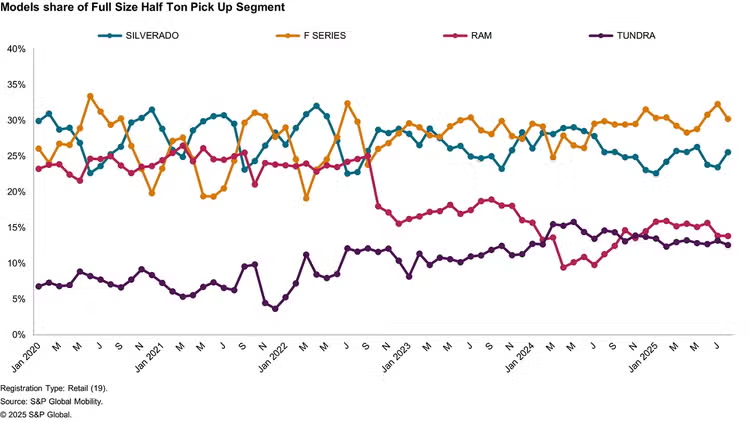
Not all models, however, perform the same in sales. The Ford F-Series and Chevrolet’s Silverado, the segment leaders, have remained in front throughout this decade, and their market shares are inversely correlated with one another: as one increases, the other declines. In contrast, the Dodge Ram’s position has deteriorated since mid-2022 and is just now beginning to improve, while the Toyota Tundra gained share from January 2022 to May 2024 but is now plateauing. (See chart below.)
The impact of brand loyalty
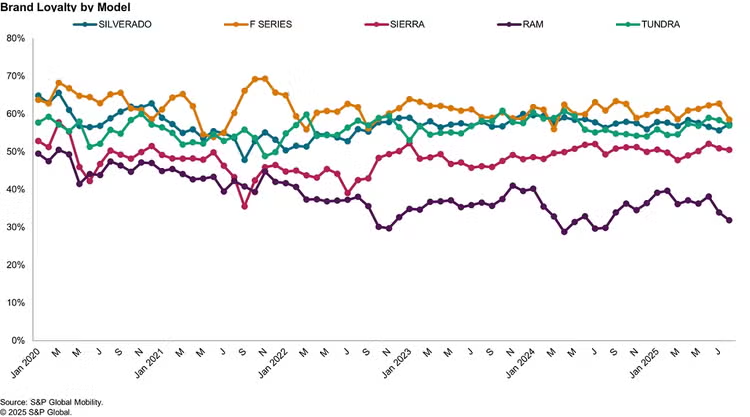
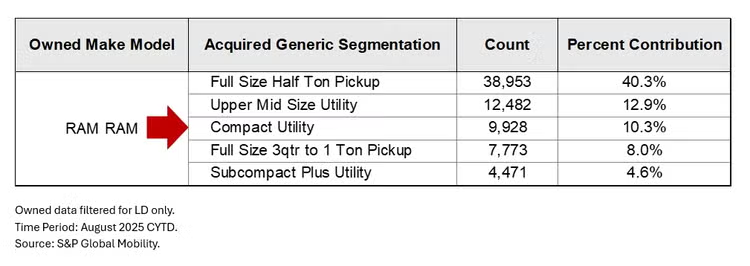
Brand loyalty drives each model’s sales performance. One contributor to the Ram 1500’s recent decline is its low retention rate. As shown in the chart below, the Ram 1500’s brand loyalty (the percent of return-to-market Ram 1500 households that acquire another Ram) dropped from 49.5% in January 2020 to 31.9% this past August, and this metric has been below 40% since February 2022. In contrast, brand loyalty for the Silverado 1500, F-150, and Tundra has consistently been in the 55-65% range throughout this same time period. To recover, the Ram needs to conquest customers from competing brands at a greater rate than its competitors, a challenging task.
Fierce competition shapes the market
The full-size half-ton pickup category is one of the most competitive. Not only are the per-vehicle gross profits among the highest in the industry, the F-Series is a core product—if not the core product—for Ford, driving ongoing product innovation and robust marketing dollars by all the brands in the segment.
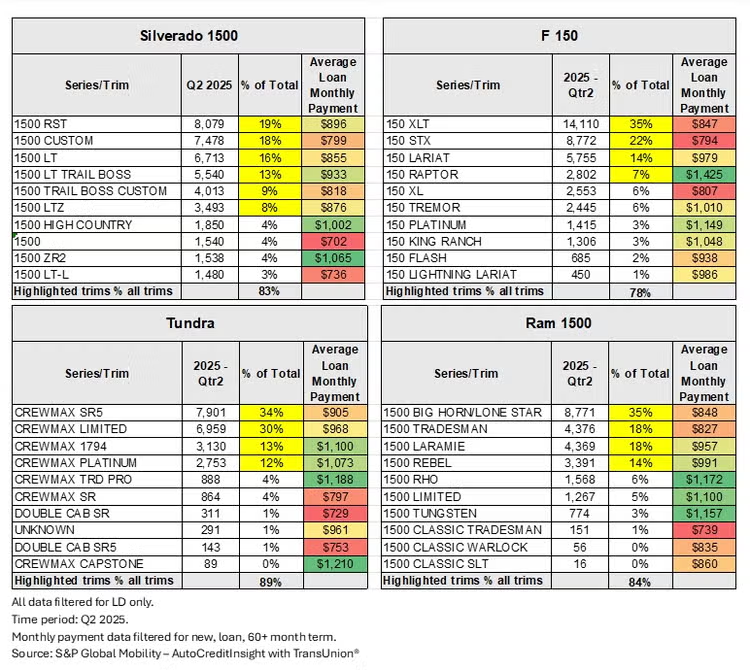
The table below displays retail registration volume and average loan monthly payments for the leading full-size half-ton pickups. The two lowest-price trim levels (among the high-volume trims) for the segment leaders—F-150 and Silverado 1500—are within $5 of one another. The Ram 1500’s lowest-price trim, the Tradesman, has only been on the market since early 2023—approximately the same time as the decline of the Ram Classic—and it would not be surprising to see that trim’s monthly payment evolve to match the low payments of its two rivals.
Influence beyond its numbers
S&P Global Mobility splits the US industry into 34 segments, each with its own unique characteristics and trends. While the full-size half-ton pickup segment is only one of these, its reach and impact far exceed its market share. By providing the foundation for larger trucks and full-size utilities, generating some of the industry’s highest per-vehicle profits and driving competition, this segment plays an outsize role in shaping overall market trends. Its importance makes it a key segment to watch for anyone tracking US vehicle trends.
S&P Global Mobility offers advanced tools for market share analysis, trend identification, sales forecasting, and competitor benchmarking, allowing OEMs to optimize sales, manage inventory, and implement targeted marketing strategies. Download a data sample to see a preview.
Stay ahead of the US auto market
S&P Global Mobility provides OEMs with comprehensive, real-time data on new and used vehicle registrations, vehicles-in-operation (VIO), and owner demographics.
Covering 97% of US and Canada vehicle sales, customers can see detailed data on make, model, body type, fuel type, emissions, sales channels, owner types, and geographic location.
With advanced tools for market share analysis, trend identification, sales forecasting, and competitor benchmarking, OEMs can optimize sales, inventory management, and targeted marketing strategies.