
Why helium supply is becoming a bigger risk for advanced semiconductor manufacturing
Could helium become the next semiconductor bottleneck? Explore the risks facing advanced chipmakers, AI and automotive supply chains.
- Why is helium important in semiconductor manufacturing?
- Why helium matters for EUV lithography
- Why is helium hard to store and transport?
- Qatar holds one of the industry’s most important helium supplies
- What factors drive helium market prices?
- Not every chipmaker faces the same helium supply risk
- What happens next for chipmakers?
Advanced semiconductor manufacturing depends on stable helium supply. While production isn’t at risk today, growing tensions around the Strait of Hormuz are raising new questions about the long-term security of global supply.
Chipmakers have so far avoided major disruptions thanks to inventory stockpiles and emergency sourcing arrangements, but if disruptions persist into late 2026, they could affect the broader semiconductor supply chain from advanced semiconductor manufacturing to AI infrastructure, memory markets and automotive electronics.
Why is helium important in semiconductor manufacturing?
Helium is one of the semiconductor industry’s most important materials, particularly in EUV lithography, wafer cooling and thermal management processes used to produce advanced chips. Without it, manufacturers would struggle to efficiently produce the AI processors, advanced memory and automotive semiconductors that power today's most demanding applications.
In leading-edge fabrication plants, helium supports a range of manufacturing processes beyond cooling. It helps stabilize production environments, purge optical paths, detect leaks and clean production chambers. These functions are especially important for manufacturing chips below the 7-nanometre process node, including AI accelerators, advanced automotive system-on-chips (SoCs), high-performance DRAM and high-bandwidth memory (HBM).
EV battery industry embraces a multi-chemistry future
Why helium matters for EUV lithography
Why is helium hard to store and transport?
Qatar holds one of the industry’s most important helium supplies
Helium is typically recovered as a by-product of natural gas production before being refined into industrial-grade and semiconductor-grade helium.
In 2025, Qatar produced around 63 million cubic meters of industrial helium, accounting for roughly one-third of global supply, making it the world’s second-largest producer after the United States. Most of Qatar’s helium exports travel through the Strait of Hormuz, a strategically sensitive shipping route. A prolonged instability in the region could significantly affect the global helium supply chain, particularly for semiconductor manufacturers in Asia, including Taiwan and South Korea, where much of the world’s advanced semiconductor production is concentrated.
What factors drive helium market prices?
Alternative supply sources are limited. Helium prices are largely driven by supply availability, transportation constraints, geopolitical disruptions and demand from semiconductor, healthcare and scientific industries.
Although the United States is the largest helium producer globally, most of its production is consumed domestically. Russian helium exists as another potential source, but access remains difficult for many Western-aligned companies due to geopolitical considerations. Semiconductor manufacturers are therefore increasingly investing in helium recovery and recycling systems. Current recycling rates range from roughly 50% to 90%, although some helium is inevitably lost through leakage.
Not every chipmaker faces the same helium supply risk
Exposure to helium shortages varies across semiconductor companies and regions. Asian manufacturers are the most vulnerable because they rely heavily on imported helium. South Korea, for example, sourced nearly two-thirds of its helium imports from Qatar in 2025. This puts major memory manufacturers such as Samsung Electronics and SK Hynix at greater risk. Taiwan and parts of China also depend heavily on helium transported through sensitive maritime routes, making future supply less predictable.
Helium production 2025 (million cubic meter)
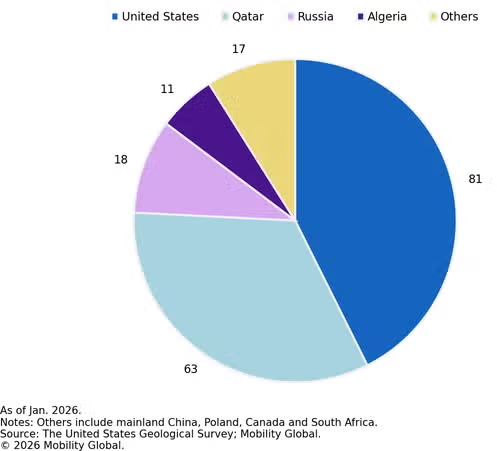
Risk is especially high for advanced fabrication plants using EUV lithography and manufacturing technologies such as gate-all-around (GAAFET) transistors and advanced 3D NAND memory. These production processes consume more helium and are highly sensitive to supply quality and availability. Any disruption could reduce yields and affect production reliability.
Which semiconductor companies face the greatest exposure?
Samsung is one of the most exposed semiconductor companies. They are heavily involved in both advanced logic chips and cutting-edge DRAM manufacturing, which are among the most helium-intensive segments of the semiconductor industry. Samsung is also a major supplier of LPDDR5 memory, AI memory products and advanced automotive SoCs. Reports indicate that Samsung had inventory sufficient through approximately the second quarter of 2026 and has since moved to secure long-term helium contracts tied to US supply sources. Its exposure extends beyond consumer electronics into advanced automotive platforms that depend on high-performance memory and computing systems.
SK Hynix faces similar risks due to its leadership in advanced DRAM and HBM production. As global AI demand continues to grow, the company’s dependence on helium-intensive manufacturing processes also increases. While SK Hynix has reportedly secured additional helium contracts, prolonged instability in the Strait of Hormuz could still tighten supply.
TSMC faces significant exposure because it operates the world’s largest concentration of advanced EUV-based manufacturing. Its production supports AI processors, smartphone chips and automotive computing platforms. However, the company appears better prepared than some competitors due to robust inventory management, strong supplier relationships and extensive contingency planning. Although no immediate disruptions are expected, a prolonged helium shortage could eventually affect TSMC as EUV utilization continues to increase.
Micron Technology is better positioned than its competitors thanks to its access to US helium supply. However, it is not immune to risk, as important parts of its manufacturing operations are located in Taiwan and Singapore. This leaves portions of its advanced memory production exposed to regional supply-chain uncertainties.
US-based manufacturers such as Intel enjoy a significant advantage due to their proximity to domestic helium sources in states such as Texas, Wyoming, Kansas and Oklahoma. They also supplement supply through imports from Algeria. This reduces their dependence on Middle Eastern shipping routes and lowers direct exposure to Strait of Hormuz disruptions. Nevertheless, their helium consumption can influence overall market availability because large semiconductor companies often secure significant supply volumes.
Chinese semiconductor manufacturers may face a different situation. Companies such as SMIC and memory producer CXMT could benefit from access to Russian helium supplies. While this may provide greater resilience against immediate shortages, the long-term reliability and scalability of Russian helium supply chains remain uncertain.
For the automotive industry, the greatest risk lies in advanced electronics rather than traditional semiconductor components. Legacy products such as microcontrollers, analog ICs, silicon carbide power semiconductors and most LPDDR4-based systems are relatively insulated because they do not depend heavily on EUV manufacturing. In contrast, advanced cockpit systems, ADAS platforms, AI-enabled computing architectures, LPDDR5/LPDDR5X memory and next-generation NAND flash are much more vulnerable.
The automotive memory market already faces pressure from the industry’s transition toward LPDDR5X and eventually LPDDR6. At the same time, memory manufacturers increasingly prioritize higher-margin products such as HBM and AI-focused memory solutions. If helium shortages become prolonged, suppliers are likely to allocate scarce advanced production capacity to AI servers, HBM and premium computing applications rather than automotive customers.
To address these risks, semiconductor manufacturers are pursuing several mitigation strategies. Many are securing long-term helium contracts from suppliers such as Linde and Air Products, often linked to North American helium sources. However, increased competition for non-Qatari helium is expected to raise costs and favor larger companies with stronger purchasing power. At the same time, Samsung, SK Hynix and other manufacturers are expanding helium recycling and recovery programs to reduce consumption and improve resource efficiency.
What happens next for chipmakers?
The semiconductor industry currently has enough inventory, contingency planning and alternative sourcing arrangements to manage short-term helium disruptions and avoid a widespread helium shortage. However, if instability in the Strait of Hormuz continues through late 2026, the industry could face tighter helium allocation, advanced-chip production constraints, higher memory prices and increasing prioritization of AI-related products over automotive applications.
What's next in the world of automotive procurement?
See how automakers are rethinking sourcing in a world shaped by global tensions, the Iran war, regulation, and software-driven vehicles.
Explore our analysis of The Future of Carmaker's Procurement 2026.
- How OEMs are actually applying constraint-based sourcing
- Where costs are rising—and where they’re worth it
- What “best cost” really looks like in practice
- How digital and AI-driven tools are changing procurement decisions