
From software-defined to AI-defined: The rise of agentic AI in vehicles
Discover how agentic AI is enabling AI-defined vehicles that can reason, act and improve continuously across driving, safety and UX.
- Where AI processing happens: The edge versus the cloud
- How agentic AI is reshaping driver assistance
- From voice commands to intelligent assistants
- Optimizing vehicle performance, comfort and energy use
- Smarter over-the-air updates
- How agentic AI strengthens vehicle cybersecurity
- AI-defined vehicles: Market adoption and key players
- Outlook for agentic AI in vehicles
As agentic AI moves into vehicles, the ability to integrate AI agents is becoming a key competitive advantage—provided automakers can deploy them safely, securely and at scale.
The next competitive battleground in the automotive industry isn’t simply software: It’s agentic AI in vehicles. As the industry moves beyond the software-defined vehicle toward the AI-defined vehicle, software is evolving from a tool for updating features to a system that can reason, adapt and make decisions.
While generative AI “thinks” by producing insights, text and recommendations, agentic AI “does” by acting on its own to execute tasks. That shift has implications across the vehicle, from autonomous vehicle technology and driver assistance to cybersecurity and over-the-air (OTA) updates.
Where AI processing happens: The edge versus the cloud
One of the most important roles for agentic AI is deciding which tasks should be processed inside the vehicle—known as the “edge”—and which can be handled in the cloud. The edge processes tasks that require immediate responses or involve sensitive data, while the cloud handles more compute-intensive work that doesn’t need to happen in real time.
Safety-critical functions such as braking, lane assist, driver monitoring for fatigue and distraction and core voice commands typically run at the edge to maintain operation even when connectivity is limited.
The cloud is better suited for tasks such as running large language models (LLMs), optimizing traffic and charging routes, managing OTA updates and supporting connected ecosystems across vehicles, mobile devices and smart homes.
EV battery industry embraces a multi-chemistry future
How agentic AI is reshaping driver assistance
Deciding where AI processing happens is only part of the story. The bigger shift is how agentic AI changes the way vehicles perceive, “reason” and respond to the world around them. Traditional advanced driver assistance systems (ADAS) follow a linear process: sense the environment, apply set rules and take action. Agentic AI, in contrast, introduces goal-driven behaviors, allowing the system to make trade-offs among safety, efficiency and comfort before deciding how to respond.
To make decisions, agentic AI combines sensor perception, maps and vehicle telemetry with a reasoning layer, goal evaluation and a continuous feedback loop to plan multiple steps ahead and continuously learn. The result is a system that can better navigate unstructured roads and ambiguous conditions more flexibly than fixed rules.
Tesla is a case in point. Tesla’s Full Self-Driving (FSD) and robotaxi systems perceive the environment through vision-based AI; plan a path; control steering, braking and accelerating; and adapt to real-world scenarios.
From voice commands to intelligent assistants
Agentic AI isn’t limited to driving functions. It’s also changing how drivers interact with their vehicles. In-car assistants are one of the first places drivers will experience agentic AI in vehicles. Instead of simply responding to commands, AI-powered agents engage in conversations and can understand context, preferences and operational constraints. They can adapt their responses based on driving mode, driver patterns, cabin conditions and the driving environment.
Agentic AI builds on earlier generations of voice assistants. Rule-based systems rely on fixed command wording, while LLM-based systems support natural language. Agentic AI assistants go a step further, combining natural language with vehicle data and sensors for more sophisticated reasoning. For example, instead of requiring an exact command to place a call, an agentic assistant can infer who you mean when you say “Connect me to John.” It can also explain how the vehicle will handle pedestrians or incorporate real-time traffic conditions into navigation guidance.
Optimizing vehicle performance, comfort and energy use
Beyond the driver experience, agentic AI helps vehicles continuously optimize performance, efficiency and comfort instead of relying on fixed settings. In active suspension, for instance, AI agents can interpret road surface characteristics, vehicle motion parameters and upcoming terrain transitions. In powertrain optimization, agents can monitor torque demand, engine parameters, driver style, thermal boundaries and regulatory constraints, then adjust fuel injection, energy distribution and boost pressure. Agentic AI can also control the cabin, adjusting heating, ventilation and air conditioning, seat position and lighting.
Agentic AI can also pre-lock doors in risky environments, pre-adjust suspension for upcoming road conditions and prepare lighting for tunnels or poor visibility. In hybrids, agents can decide when to use the internal combustion engine versus the electric motor to optimize fuel efficiency and battery usage.
Smarter over-the-air updates
Agentic AI can make OTA updates more predictive and efficient. Agents decide when and what to update based on vehicle usage patterns, driver behavior, climate, terrain and network conditions. Updates can be selectively deployed rather than pushed to every vehicle at the same time, and the probability of failure can be predicted before deployment.
The technology can automate the entire update process, from testing and deployment to monitoring and rollback. If an update fails, the system can retry or restore a previous software version automatically. Agentic AI can also coordinate updates across ADAS, infotainment and powertrain systems and use fleet data and digital twins to identify issues before they become widespread.
For automakers, this leads to smarter revenue strategies such as dynamic feature pricing, usage-based upgrades, faster feature rollout cycles and lower recall or service campaign costs.
How agentic AI strengthens vehicle cybersecurity
Agentic AI changes vehicle cybersecurity from a reactive process to a proactive, autonomous and continuously adapting system. Traditional cybersecurity relies on known threat signatures, manual incident response and periodic updates. Agentic AI agents can continuously monitor vehicle systems, detect unusual behavior, learn from new threats in real time and respond without waiting for human intervention.
At the vehicle level, agentic cybersecurity monitors CAN and Ethernet traffic patterns, electronic control unit (ECU) behavior deviations, unauthorized access attempts and sensor-spoofing signals. Instead of relying on a single security module, specialized agents can focus on areas like network security, identity and access, OTA security, application security and cloud security. When a threat is detected, the agent can isolate a compromised ECU or domain, block malicious communication, roll back to a safe software version, switch to fail-safe driving mode and alert the automaker.
AI-defined vehicles: Market adoption and key players
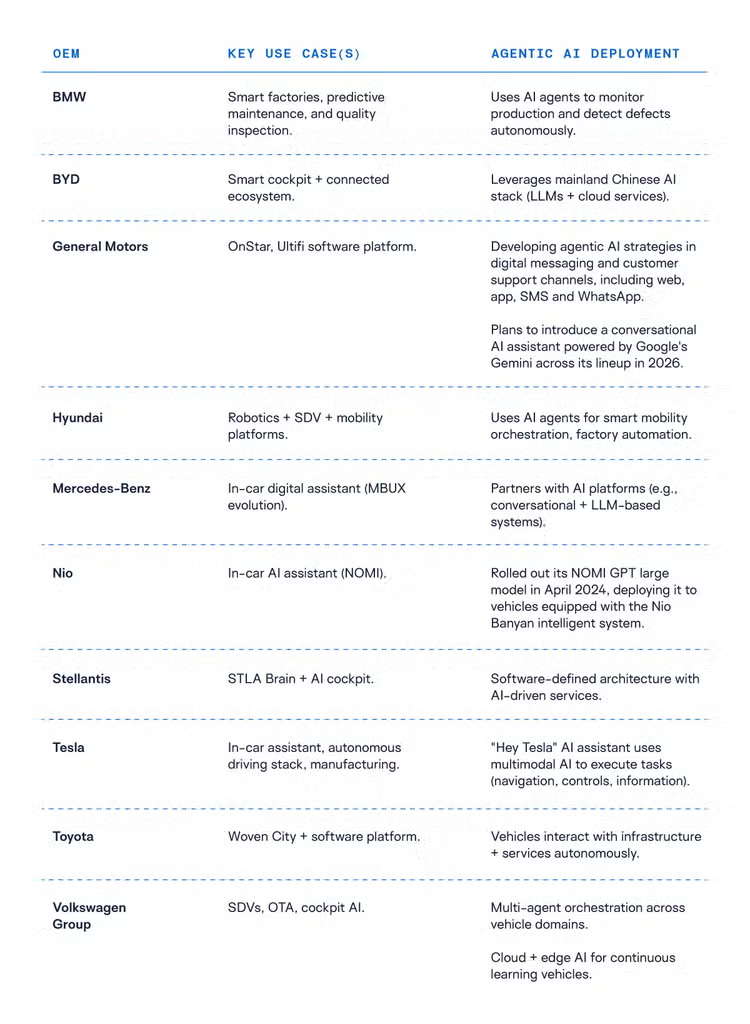
Agentic AI adoption in vehicles is accelerating, but the market is still taking shape. According to Mobility Global data, penetration of in-vehicle agentic AI chatbots will rise from about 8% in 2025 to nearly 31% in 2031. True conversational, agentic usage, however, is still evolving. Most agentic AI chatbots are deployed for in-cabin conversational use cases, such as navigation, infotainment, vehicle controls and queries about the vehicle manual and features.
The automotive agentic AI space includes a wide range of players, with no single company dominating the market. Suppliers span three main areas: automotive-specific AI platforms for the cockpit, vehicle and dealership; engineering and IT service providers; and the broader AI, cloud and chip ecosystem.
Key vendors include Amazon Web Services, Cerence, Nvidia, Salesforce and Sonatus, among others.
Outlook for agentic AI in vehicles
Agentic AI is evolving from a single vehicle feature into a broader capability that can influence the entire automotive value chain. When integrated into engineering, manufacturing and mobility workflows, AI agents help vehicles become more adaptive, assistants more contextual, OTA updates more predictive and cybersecurity more responsive.
That said, the market is still forming, adoption is uneven and many deployments remain agent-like rather than fully autonomous. Many unanswered questions remain. Are AI-driven decisions safe for critical functions like steering, braking, acceleration and autonomous driving under all operating conditions? Who is responsible when an AI agent makes a wrong decision?
Ultimately, agentic AI is only as effective as the data it learns from. The ability to identify high-value data and continuously improve AI agents is slowly but surely becoming a key competitive differentiator. The biggest obstacles are not the AI models themselves, but ensuring that autonomous agents are safe, secure, certifiable and economically viable in a highly regulated industry. Companies that can successfully accomplish this will be best positioned to compete as AI-defined vehicles become a reality.