
Rising vehicle mass drives new lightweighting strategies in mainland China
Discover how rising vehicle weight is driving vehicle lightweighting in China through multimaterial designs, gigacasting and advanced steels.
Automakers in mainland China face a growing challenge from rising vehicle mass, which can reduce fuel efficiency and increase CO₂ emissions in internal combustion engine (ICE) vehicles and diminish driving range in electric vehicles (EVs).
Several factors are driving the increase in new vehicle curb weight:
- Larger vehicles. Strong consumer demand for larger vehicles has led Chinese automakers to adopt larger body structures, longer wheelbases and bigger wheels.
- More technology and features. The growing integration of advanced driver assistance system (ADAS) hardware, safety, connectivity and comfort features adds further weight.
- EV components. Larger battery packs, electric motors, power electronics, thermal management systems and battery protection structures are increasing EV weight. To support this additional load while maintaining safety and structural integrity, EVs generally require a more robust body-in-white (BIW) and chassis systems, further increasing vehicle mass.
Multimaterial architectures help reduce rising vehicle weight
The added vehicle mass has created challenges related to energy efficiency, material utilization and the long-term funding of road infrastructure maintenance. As a result, industry experts and policymakers in mainland China have increasingly discussed reforms to vehicle taxation and road-use charging mechanisms, including approaches linked to vehicle mass, to encourage more sustainable vehicle development.
Against this backdrop, mainland Chinese automakers are pursuing vehicle lightweighting strategies to improve efficiency. These efforts range from increasing the use of lightweight materials such as aluminum and magnesium to incorporating advanced high-strength steels in place of conventional steel when feasible. They are also redesigning vehicle architectures to eliminate unnecessary structures and integrate multiple functions into single components, giving rise to a multimaterial, highly integrated BIW strategy.
For battery electric vehicles (BEVs), Chinese automakers are increasingly integrating battery packs into the vehicle structure. These approaches enable the battery pack to serve structural functions, reducing the need for redundant floor structures, brackets and reinforcements.
Steel is being upgraded, not replaced
Mainland Chinese automakers are increasingly using advanced steel grades, including high-strength steel (HSS), advanced high-strength steel (AHSS), ultrahigh-strength steel (UHSS) and gigapascal-grade steels, to reduce vehicle mass while meeting increasingly stringent structural requirements. The growing weight of BEVs has increased the importance of advanced steels, as heavier vehicles generate higher crash loads and require stronger passenger safety cells to maintain crashworthiness and occupant protection.
According to Mobility Global, while total steel consumption in mainland China will remain relatively stable over the next decade, the mix of steel grades in BIW will change significantly, reflecting automakers’ vehicle lightweighting and safety priorities.
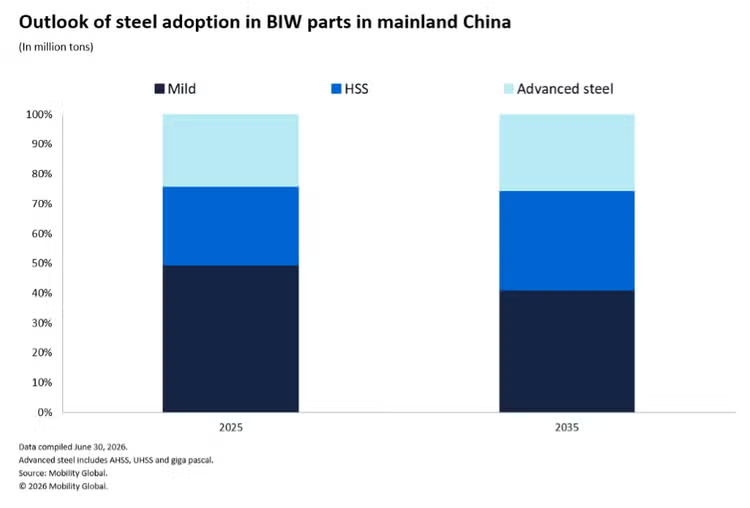
Major domestic steel suppliers are developing higher-strength steel grades for EVs, so OEMs can reduce material thickness while maintaining structural integrity. Automakers are instead concentrating steel in areas where crashworthiness and battery protection are most critical.
The rise of aluminum and gigacasting
The use of aluminum is also rising, particularly in new energy vehicles (NEVs), but it is not simply replacing steel. Most automakers are adopting a multimaterial strategy, using aluminum where it delivers the greatest vehicle mass savings while retaining AHSS for safety-critical structures.
The growth of integrated die-casting technologies—often referred to as gigacasting or megacasting—has accelerated this shift. By replacing dozens of stamped steel components and hundreds of weld points with a single large aluminum casting, manufacturers can simultaneously reduce vehicle mass, improve structural stiffness and simplify production. Mobility Global forecasts that aluminum usage in the BIW of vehicles produced in mainland China will grow at a compound annual growth rate (CAGR) of 6.5% from 2025 to 2035.
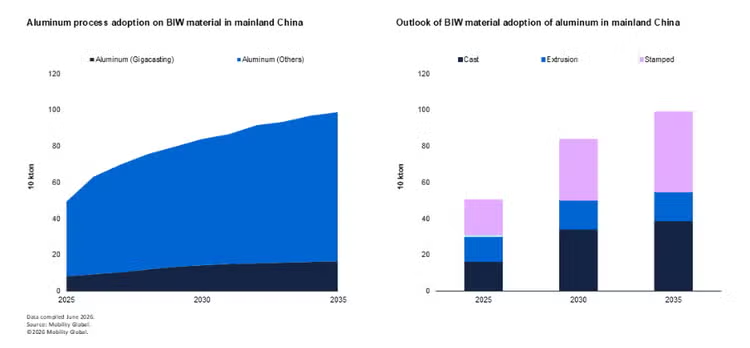
Although traditional automakers are expanding gigacasting as part of their vehicle lightweighting strategies, EV startups are expected to adopt a more measured approach, with gigacasting deployment likely to stabilize over the next decade as product strategies mature and price competition intensifies.
As a result, while production capacity is projected to increase significantly in the coming years, the industry is unlikely to experience a proportional rise in gigacasting demand, particularly in the near term. The mismatch reflects the high upfront capital requirements, costly tooling modifications and limited number of vehicle platforms currently designed to support large-scale castings.
Over the longer term, broader OEM adoption could help demand catch up. In 2025, a small number of automakers accounted for more than 95% of gigacasting volume. By 2035, however, a much broader range of OEMs, including established traditional manufacturers, is expected to adopt the technology, moving gigacasting beyond early adopters.
At the same time, advances in vehicle electrification are expected to expand the range of gigacasting applications. At present, single-piece gigacastings are primarily used to integrate structural components in the rear floor section of conventional BIW architectures. Looking ahead, automakers are likely to use larger gigacastings for battery enclosures, broadening the technology's application.
Magnesium alloys gain momentum, but in niche applications
Magnesium is emerging as another important material in mainland China's vehicle lightweighting strategy. In 2020, the country launched the Technology Roadmap for Energy-Saving and New Energy Vehicles 2.0, which set ambitious targets to increase average magnesium content per vehicle from 15 kg in 2020 to 45 kg by 2030. Meeting this target will require magnesium to move beyond niche applications into larger, load-bearing BIW components, where the potential for vehicle mass reduction is greatest.
Mainland China accounts for more than 70% of global magnesium production and benefits from a highly localized supply chain. Magnesium is also cheaper than aluminum in the domestic market. Despite these advantages, automotive adoption remains limited by corrosion susceptibility, surface-treatment requirements and less mature processing technologies for large structural applications compared with aluminum and steel.
Recent advances in semisolid die-casting technologies are helping overcome some of these barriers and are expanding the use of magnesium beyond brackets and interior components to structural BIW applications.
Vehicle lightweighting outlook for Chinese automakers
Steel is expected to remain the dominant BIW material in mainland China through 2035, with overall consumption remaining relatively stable despite increasing vehicle lightweighting efforts. However, the mix will shift toward higher-value grades as automakers replace mild steel with stronger, lighter alternatives. HSS is forecast to record the largest gains as OEMs seek to improve crash performance, reduce vehicle mass and maintain cost competitiveness. AHSS, UHSS and gigapascal-grade steels are also expected to grow, particularly in EV platforms.
Total aluminum demand in BIW applications is projected to nearly double from 2025 to 2035. While conventional stamped aluminum applications will continue to account for the majority of volumes, demand for cast aluminum is expected to grow rapidly as OEMs expand the use of gigacasting for structural components. This trend reflects the industry's pursuit of manufacturing simplification, part consolidation and lower assembly costs.
Overall, the mainland Chinese BIW market is expected to evolve toward multimaterial architectures that combine advanced steels, aluminum and, in selected applications, magnesium. As automakers balance lightweighting, safety, cost and manufacturing efficiency, material optimization and structural integration will become increasingly important competitive advantages.
Build future-ready EV strategies
Our E-Mobility Technology Module helps you take the guesswork out of EV planning with the industry's most advanced EV data, deep technology and sales insights to power confident product and market decisions.
Combine granular vehicle specifications including performance, range, dimensions and payload with forward‑looking technology trends like battery innovation, charging behavior, and electric power to anticipate how vehicles will evolve and align product strategies to real market demand, reducing risk and ensuring new models meet future customer expectations.