
Why battery manufacturers are prioritizing allocation over expansion
Learn why battery manufacturers are prioritizing capacity allocation over expansion, shifting production to energy storage systems as EV demand growth slows.
Battery manufacturers redirect capacity as expansion slows
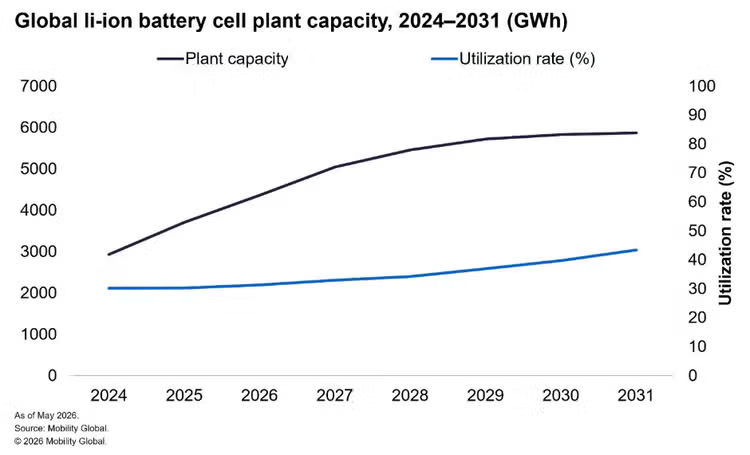
Mobility Global forecasts total lithium-ion cell manufacturing capacity to grow at a healthy 10.4% CAGR from 2024 to 2031, effectively doubling over the period. But the nature of that growth is changing. Most near-term capacity additions are now concentrated in projects already under construction, while new gigafactory announcements have slowed considerably. The battery boom has not ended, but the era of indiscriminate capacity expansion has.
In 2024, global battery demand from the light-vehicle segment remained below 900 GWh, translating into a global battery plant utilization rate of just 30.2%. By 2031, we expect utilization to improve to 43.4%—not because demand is accelerating, but because the battery industry is taking a more disciplined approach to capacity expansion. A growing number of planned battery projects have been delayed, downsized or repurposed for non-EV applications as battery manufacturers reassess long-term demand and investment priorities.
This shift is clearly visible in Mobility Global's Auto Battery-Cell Production Capacity Tracker. Compared with the H1 2025 edition, the H1 2026 update tracks approximately 28 fewer battery plants worldwide. The contraction has been particularly pronounced among early-stage projects, with the number of planning-stage plants falling to one-third the level recorded in the H1 2025 update. Over the same period, the number of under-construction plants also declined by 14. This is more than a temporary slowdown in project announcements; it represents a tangible rationalization of future battery capacity as EV battery manufacturers prioritize capital efficiency and reassess demand.
A key outlet for this excess battery-cell capacity is the stationary ESS market. As EV demand growth moderates, EV battery manufacturers are redirecting several facilities originally intended for automotive applications toward ESS. The LG Energy Solution-Honda joint venture plant in Ohio illustrates this shift: initially planned as an EV battery facility, it is now mass-producing cells for energy storage applications. Similarly, Ultium Cells has started mass production of lithium iron phosphate (LFP) battery cells for ESS at its Tennessee plant, while LG Energy Solution plans to begin ESS cell production at its Lansing, Michigan, facility before year-end.
Greater China maintains its battery capacity lead as regional outlooks diverge
The shifts in battery manufacturing are playing out differently across regions, reflecting variations in demand, investment and supply chain priorities.
China
Greater China is expected to retain its dominant position in global battery production capacity over the forecast period. In 2025, the region accounted for 65% of global battery manufacturing plants and approximately 78% of total installed production capacity. We forecast its share of global capacity to remain substantial at around 76% by 2030.
Despite its market leadership, Greater China continues to face domestic overcapacity challenges driven by years of rapid investment and capacity expansion. In response, authorities have introduced measures to strengthen capacity oversight and discourage excessive competition across the battery value chain. Nevertheless, while capacity growth in Greater China is moderating, the faster retrenchment of investment plans in other regions is reinforcing the region's relative advantage. As a result, Greater China's dominance in global battery manufacturing capacity is likely to prove more resilient than previously anticipated.
North America
North America represents the most pronounced example of the battery industry's transition from EV-focused battery manufacturing toward ESS. Compared with our H2 2025 update, we have reduced the projected battery demand from the light-vehicle segment for North American battery manufacturing plants in 2030 by nearly 42%. Total production capacity has also been scaled back, with the 2030 forecast declining by 22% as a growing number of projects are either canceled, postponed or repurposed to serve the ESS market.
Europe. Europe faces an equally significant challenge. While the region's strategic ambition to build a self-sufficient battery industry remains intact, factors such as high manufacturing capital requirements and weaker EV demand growth have created significant headwinds for industry expansion. Project delays, postponements and cancellations continue to undermine localization efforts, with five plants removed from our tracker in the latest update. Nearly a dozen remain planned or under construction, but the risk profile has changed dramatically.
Japan and Korea. Japan and Korea have maintained a comparatively stable position in the global battery sector, but weakening demand is creating increasing pressure on future capacity utilization. The region's projected 2030 battery-cell production capacity has risen slightly, increasing by around 3% compared with the previous update. However, this modest capacity growth masks a significant deterioration in demand. Expected battery demand from the light-vehicle segment has been reduced by more than 26%, reflecting slowing EV adoption and renewed momentum for hybrid vehicles across several key markets. As a result, projected 2030 capacity utilization has fallen sharply, from 44% to just 31%.
South Asia
South Asia stands out as the clear exception to this trend. It is the only region where capacity expectations have increased in the latest update, driven primarily by previously unreported capacity at the LG Energy Solution-JSW facility in India and REPT Energy's plant in Indonesia. The region's outlook continues to be supported by ongoing efforts to localize battery supply chains and reduce reliance on imports. This push is closely tied to the electrification ambitions of regional automakers, which are increasingly seeking to establish integrated domestic EV manufacturing and battery supply chain ecosystems.
Battery manufacturers recalibrate growth strategies
Battery manufacturers’ strategies are increasingly defined by manufacturing flexibility, chemistry diversification and geopolitical risk management. The emerging playbook is pragmatic: diversify chemistries, localize selectively, safeguard utilization rates and ensure factories can serve multiple end markets rather than relying solely on EV growth.
SK On, for example, is expanding its Georgia plant to support dual-chemistry production for both EV and ESS applications, a move partly driven by tighter US restrictions on mainland Chinese battery imports. In contrast, Gotion has suspended plans for its $2.4 billion Michigan facility amid local opposition.
These decisions highlight a broader shift: battery manufacturers are no longer pursuing capacity growth for its own sake but are redesigning their EV battery manufacturing footprints around flexibility and resilience. LG Energy Solution exemplifies this trend, increasingly balancing EV and energy storage demand while accelerating its move into LFP production for cost-sensitive vehicle programs and grid-scale storage applications.
Panasonic, meanwhile, is emphasizing customer alignment, next-generation manufacturing processes and higher-energy-density cells.
Samsung SDI and its partners have adopted a more cautious stance, slowing or reassessing projects where vehicle demand no longer justifies original investment assumptions. Meanwhile, mainland Chinese battery manufacturers such as CATL and BYD continue to leverage scale advantages while expanding into energy storage, technology licensing and overseas partnerships to mitigate geopolitical and trade-related risks.
Battery industry resets around disciplined capacity growth
For battery manufacturers, the next phase will be defined less by how quickly capacity can be added and more by how effectively it can be deployed, repurposed and monetized across an evolving energy landscape.
This shift is also redefining success. Gigawatt-hour announcements, once viewed as a measure of competitive strength, carry less weight without proven demand, chemistry flexibility, resilient supply chains and stable policy frameworks. The strongest players will be those that can sustain factory relevance through demand cycles, redirect production toward the most resilient applications and align technology roadmaps with both cost pressures and regional market requirements.
The broader implication is that batteries are evolving from a high-growth automotive narrative into a more complex industrial infrastructure asset. They increasingly sit at the intersection of mobility, power systems, renewable integration, industrial resilience and energy security. Viewed in this context, the current slowdown represents a necessary market correction rather than a retreat.
In shedding some of its earlier EV-driven exuberance, the battery industry is laying the foundation for a more durable future: one in which capacity growth is slower but more disciplined, suppliers are fewer but more competitive and batteries become more deeply embedded in the global energy system.
Build future-ready EV strategies
Our E-Mobility Technology Module helps you take the guesswork out of EV planning with the industry's most advanced EV data, deep technology and sales insights to power confident product and market decisions.
Combine granular vehicle specifications including performance, range, dimensions and payload with forward‑looking technology trends like battery innovation, charging behavior, and electric power to anticipate how vehicles will evolve and align product strategies to real market demand, reducing risk and ensuring new models meet future customer expectations.