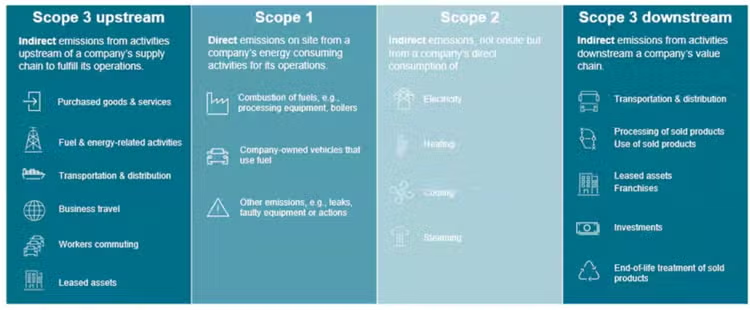
Carbon Accounting - Upstream
Upstream materials, goods and services often contribute 15-20% of a traditional automaker's and auto supplier's carbon profile. But understanding your carbon footprint and benchmarking against your peers is challenging.
- Quantifying a carbon profile is complex, especially for Scope 3, Category 1 (Upstream goods and services).
- Public data resources are hard to access and often times inconsistent.
- Value chain carbon accounting requires a combination of data from different sectors (energy, supplier, materials, etc.).
- Many manufacturers lack in-house expertise in climate modeling and carbon markets.
S&P Global Mobility can help. With our Carbon Accounting Upstream Solution – you can quickly and easily access upstream carbon outputs by manufacturer, brand and vehicle. With our proprietary information you can:
- Quantitatively assess the material-based carbon footprint and decarbonization trajectories
- Manage sourcing and/or investment portfolios related to regulatory or reporting requirements
- Identify supply chain carbon hotspots and evaluating decarbonization opportunities
- Inform decarbonization strategies with consistently built global datasets and comprehensively comparable results
Introducing Carbon Accounting – Upstream: Scope 3, Category 1
The Sustainable Mobility Scope 3 Category 1 offering provides comprehensive datasets of global car manufacturers' and vehicle models’ upstream material embedded carbon emissions.
Using reliable data sources and a consistent methodology, the database allows automotive stakeholders to:
- Self-report
- Set industry benchmarks
- Track industry/corporate decarbonization target fulfillment
- Plan for competitive strategies
- Make supply chain or investment decisions
Key Features
- Vehicle-by-vehicle production and powertrain/alternative propulsion sourcing
- Global powertrain-based production and sales forecasts by S&P Global Mobility
- Global energy outlook by S&P Global Commodity Insights
- GREET and regional technical guidance on key material compositions and life-cycle carbon factors used in the vehicle body, engine, transmission, and battery
- Life-cycle (environmentally extended input-output, EEIO) based regional key materials carbon factors
- Country/regional energy structure changes for industrial consumption
- Bottom-up methodology built upon millions of global vehicles
- Car manufacturer and vehicle model-level upstream carbon emissions reporting

Use Cases by Industry Stakeholders
- Understand how the carbon embedded in purchased goods and services impacts the OEMs and Suppliers in investment portfolios.
- Report on investment portfolio's Scope 3 financed carbon emissions.
- Influence leadership investment decisions.
- Identify investments that have low risk exposure to carbon pricing impacts.
- Access consistent measurement methodology and reliable data across OEMs and Suppliers.
- Understand current and future carbon portfolios.
- Identify carbon hotspots in the value chain.
- Assess current and future carbon prices in different climate scenarios.
- Assess what regulations will impact carbon markets.
- Understand how changes to my product portfolio will impact my carbon portfolio.
- Accurately report your carbon profile in sustainability reports.
- Understand future Scope 3 carbon emissions.
- Identify carbon hotspots in the value chain.
- Assess current and future carbon prices in different climate scenarios.
- Improve key areas in the carbon portfolio to appeal to clients.
- Understand how regulations will impact carbon markets.
- Assess how an emission change to a product portfolio can effect overall carbon profiles.
Combine our Upstream Carbon Account solution with our Downstream solution to gain a holistic understanding of carbon emissions across the value chain.
Our Upstream Carbon Accounting Solution (Scope 3, Category 1) can be paired with a Downstream (Use-phase) Solution (Scope 3, Category 11) which accounts for 75-80% of vehicle emissions.