
Automotive pricing strategy: Luxury vs. mainstream in a volatile fuel market
One market requires two playbooks as shifting automotive incentives, powertrain demand and payment dynamics reshape OEM pricing strategy.
Explore how fuel prices, EV incentives and powertrain migration are reshaping automotive pricing strategy for luxury and mainstream OEMs.
The US automotive landscape is seeing a high-stakes tug of war between powertrain innovation and consumer affordability. When fuel prices rose 57% from January to May 2026—going from $2.96 to a peak of $4.65 and exacerbating an already strained inflationary market—the consumer response was swift and decisive.
As of August 2026, hybrid sales share climbed 3.1 percentage points, to 17.7%, year-over-year, while electric vehicle (EV) share fell 5.7 points to 7.2%. EV sales faced a sharp decline following the expiration of federal tax credits in late 2025, and the drivetrain has never fully recovered.
These shifts are forcing OEMs to rethink their automotive pricing strategies across powertrains.
Tracking how customers move across powertrains and payment channels—and how to capture and retain them—requires insight into both their migration patterns and the economics shaping where they land. The 2027 return-to-market outlook, shifting consumer behavior, and changing pricing and incentive dynamics show how those forces are playing out, and why luxury and mainstream brands will need different strategies in response.
2027 return-to-market trends: Two automotive pricing strategies
Nearly 2.5 million lessees will return to market in 2027, but their vehicle choices will be shaped by very different market conditions in their respective segments. Our 2027 return-to-market (RTM) data reveals that the luxury and mainstream sectors are operating under fundamentally different realities.
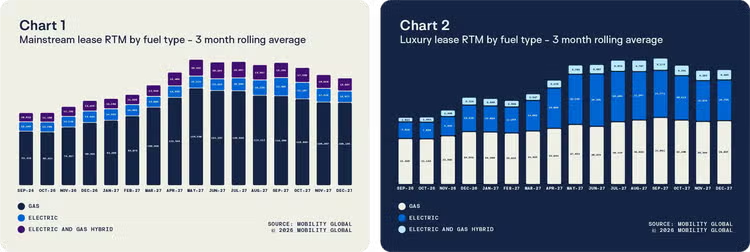
- Luxury: More than 600,000 luxury lessees will return to market in 2027, with EVs representing a disproportionately large share. EVs account for 38.1% of luxury returns while gas vehicles remain the largest segment at 54.3% and hybrids account for 7.7%. Luxury return-to-market volume averages nearly 52,000 vehicles per month, peaking in Q3. EV volume is more volatile, starting the year rather sluggish before peaking to achieve near parity with gasoline vehicles by June. (See Chart 1.)
- Mainstream: Gasoline vehicles dominate the mainstream return-to-market mix, accounting for 76.6% of volume. EVs and hybrids split the remaining 23.4%, with EV volume growing more steadily to a Q3 peak, when it overtakes hybrid volume before contracting sharply in October. (See Chart 2.)
These differences require distinct automotive pricing strategies. Luxury brands must manage greater EV exposure, while mainstream brands must protect a large gasoline base while fostering hybrid growth.
Automotive consumer trends point to a customer retention challenge
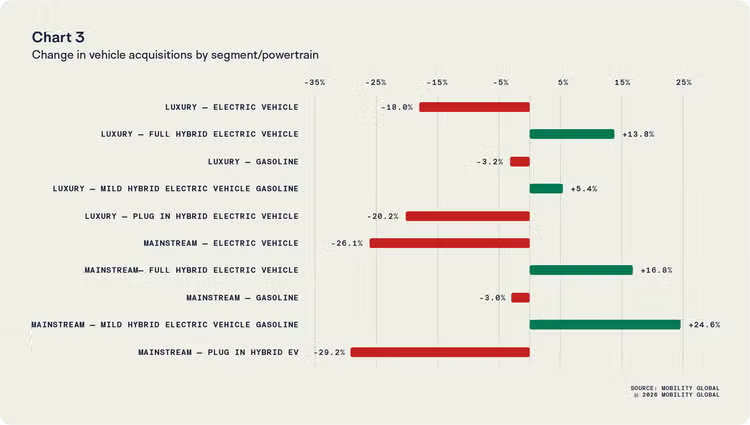
The EV segment is currently facing a significant customer retention challenge. In the 12 months ending June 2026, households that acquired luxury EVs fell 18% (H2 vs. H1), while mainstream EV acquisitions dropped by 26.1%. Retention metrics—a measure of automotive loyalty—tell a similar story: luxury EV retention fell nearly 5% to 66%, while mainstream EV retention dropped by 14% to 44%.
Hybrids are the clear traffic winners. Mild hybrids grew 24.6% in the mainstream sector, while full hybrids grew 16.8% in the luxury segment. Gas vehicles, though contracting slightly, continue to account for much of the movement across powertrain segments, representing the largest source and destination of customer migration apart from hybrids. Both mild and full hybrids serve as stable leaders, with customers cycling back into the same vehicle type. (See Chart 3.)
These automotive market trends suggest that a large portion of consumers remain sensitive to changing conditions, including policy and automotive incentives, which can shift consumer behavior faster than product lifecycles.
How automotive incentives are shifting from lease to finance
The financial experience of a customer migrating between powertrains is defined by two major shifts: a fundamental change in how they pay (lease vs. finance) and a strategic pivot in how manufacturers support those choices (automotive incentives).
As the US EV market matures, it is undergoing a structural transition in how it is funded. Historically, OEMs encouraged EV adoption by heavily subsidizing and aggressively promoting leasing. Over the past year, however, that support has shifted from leasing toward finance.
In the luxury segment, the EV lease mix has dropped by 32.9 percentage points, while the finance mix has surged by 22.2 points. A similar trend is visible in the mainstream segment, where the lease mix is down 33.6 points and the finance mix is up 28 points.
Taken together, these EV market trends suggest that lease take rates could serve as a leading indicator of segment health as consumers increasingly rely on OEM incentives to offset inflationary market pressures.
- The EV incentive gap: Customers who acquired EVs in the prior cycle benefited from peak incentive support exceeding 20% of MSRP. As these customers return to market, they will find that EV incentives have shifted from lease to finance, contributing to a $6,656 reduction in support for luxury vehicles and $2,875 for mainstream vehicles. As that support has declined, OEM pricing strategies have increasingly emphasized margin preservation, with incentives shifting toward financing and competing fuel types. This pullback in EV incentives is reshaping buyer demand, as returning customers encounter less support than they received during the previous purchase cycle and increasingly consider other powertrains.
- The gasoline alternative: As these EV defectors look for alternatives, they will find that manufacturers have pivoted their support toward more profitable gasoline alternatives, which now offer more efficient engine configurations and new tech. Vehicle incentives for gas models have risen from roughly 5% to 8.9% of MSRP in both the luxury and mainstream segments.
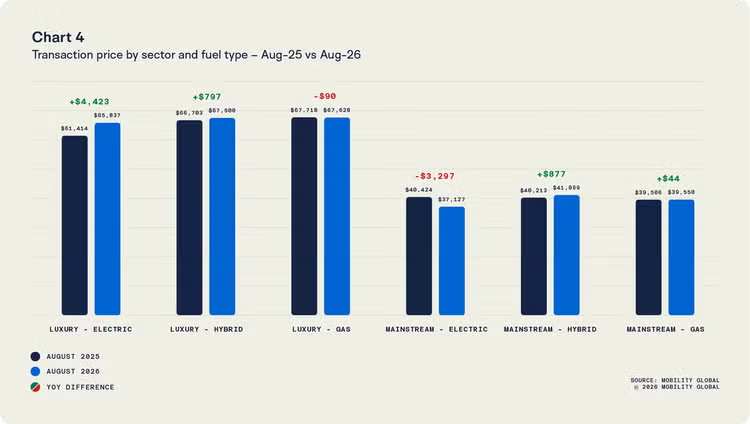
- The hybrid middle ground: For customers who migrate to hybrids, the landing is more stable, with fluctuations in transaction price and MSRP hovering around 1–2% and incentive spending changing by less than $500 per vehicle in both the mainstream and luxury segments. That relative pricing stability may help explain why hybrid vehicles are gaining market share and maintaining strong automotive loyalty, with customers more likely to remain within the same powertrain category. (See Chart 4.)
OEM pricing strategies for customer retention
The current defection trend reflects not just changing consumer preferences, but a shift in the financial conditions customers encounter as they return to market. As customers exit the EV market amid the withdrawal of peak incentive support, pricing leaders must position their portfolios to absorb returning customers and keep them within the brand. Doing so requires pricing strategies tailored to the distinct economic realities of the luxury and mainstream segments.
Luxury
Luxury return-to-market volume is characterized by greater volatility and a high concentration of EV households. The priority is customer retention: keeping customers within the brand as they move away from EVs and limiting migration to the mainstream segment. Pricing leaders can use the hybrid segment as a shock absorber, steering defectors toward these models to maintain customer experience as well as portfolio stability while deploying gas vehicles strategically to protect the premium base.
- The incentive gap: The rise in EV defection and shift away from leasing coincide with an automotive incentive gap. Pricing teams must identify customers approaching the end of an EV lease, as well as financed customers with significant equity, and target them with incentives for comparable hybrid or gas models. Dealers are already doing this using market tools. A well-designed incentive strategy can facilitate this market activity and boost brand retention.
- The channel shift: The shift from leasing to financing can serve as a leading indicator of premium buyer behavior—and a potential point of defection. Because the shift away from leasing in the EV and PHEV segments disproportionately affects the luxury market, OEMs should monitor how these changes impact future loyalty and return-to-market cycles—especially to avoid a trough effect in 2029 and 2030.
- Portfolio balance: Premium hybrids can provide a bridge for customers moving away from EVs, helping OEMs retain those customers while maintaining portfolio stability and protecting high-end margins.
Mainstream
Mainstream return-to-market volume is defined by scale and payment sensitivity. The priority is to prevent payment shock for returning EV customers while maintaining an affordable path to other powertrains. As hybrid prices rise, OEMs risk losing EV customers who might otherwise view hybrids as a lower-cost alternative to gas vehicles. Deploying gas-based incentives strategically—while insulating overall portfolio margins—will keep OEMs competitive in core segments and help retain payment-sensitive consumers.
- Customer retention: Gasoline-to-gasoline replacement represents the core of mainstream return-to-market volume. With gas incentives rising by $1,400 year-over-year, the risk extends beyond EV defection to automotive loyalty among longtime gas owners who may shop for better finance terms elsewhere. Targeted loyalty incentives and APR buy-downs for returning lessees before they enter the highly competitive open market can help close the affordability gap and improve customer retention.
- The channel shift: Lease take rates can serve as an indicator of changing behavior among payment-sensitive customers. Significant shifts in lease penetration or incentive take rates may signal increased risk of customer defection, particularly when competitors offer a more seamless financial transition.
- Portfolio balance: The hybrid segment can act as a value bridge for mainstream customers moving from either EVs or gas vehicles. In addition to providing a hedge against fuel-price volatility, hybrids offer an appealing total cost of ownership alternative. This gives OEMs another way to absorb return-to-market volume and retain customers without triggering a broad-based incentive war.
The winners will be the brands that use pricing strategies to turn return-to-market volume into an opportunity for customer retention. By aligning vehicle incentives, financing and powertrain options with changing consumer demand, OEMs can keep more customers within the brand and build long-term loyalty.
Turn powertrain migration into a retention strategy with Mobility Pulse 360
Mobility Global’s Mobility Pulse 360 provides the integrated intelligence needed to navigate this volatility. By unifying transaction pricing, incentive programs, monthly payment dynamics, and DMA-level inventory, the platform allows you to pinpoint exactly where defection risk is highest.
Whether you are steering luxury EV returners toward hybrid "bridge" models or mitigating payment shock for mainstream buyers, Mobility Pulse 360 gives you the visibility to optimize your portfolio and protect margins in real-time.
Secure your brand loyalty
Stop guessing where your customers are going. Learn more about Mobility Pulse 360 and secure your brand loyalty today.