
How can the EU turn its EV charging surplus into a global advantage?
Europe has built a robust EV charging network ahead of demand. Discover how the EU is leveraging this strategic advantage to drive profitability and mass adoption.
Europe’s EV charging network is ahead of demand
A July 20 report from the Brussels-based nonprofit Transport & Environment (T&E) found that EV charging infrastructure deployment across the European Union is running well ahead of regulatory requirements, providing a strong foundation for the next phase of EV adoption.
According to T&E, the EU had approximately 1.1 million public charging points by the end of 2025—five times as many as in 2020. More importantly, charging capacity has grown faster than the battery-electric vehicle (BEV) fleet.
Under the Alternative Fuels Infrastructure Regulation (AFIR), EU member states must provide at least 1.3 kW of public charging capacity for every BEV registered in their national fleets. According to T&E, by March 2026, every EU country except Malta had met this requirement. Collectively, the bloc exceeded the AFIR target by 180%.
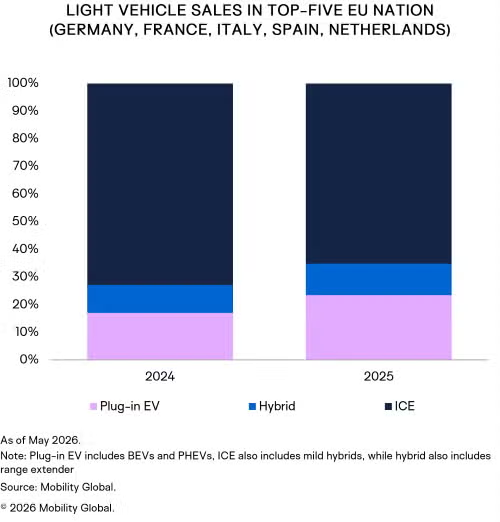
The infrastructure buildout is also beginning to align with stronger EV demand. EV sales in Europe saw double-digit growth in 2025 after a stagnant market since 2022. Mobility Global data also shows that the combined market share of plug-in hybrid electric vehicles and BEVs increased from 17% in 2024 to more than 23% in 2025 across France, Germany, Italy, the Netherlands and Spain.
As EV adoption grows, improving utilization of the EU’s existing vehicle charging infrastructure will become increasingly important.
EV battery industry embraces a multi-chemistry future
What’s driving the EU’s electric vehicle charging infrastructure growth?
Europe’s electric vehicle charging network didn’t emerge from market demand alone. Legally binding targets, long-term policy certainty, supportive climate policies and private investment all helped build the EV charging network ahead of demand.
Binding targets accelerated EV charging deployment
AFIR’s mandatory requirements gave EU member states and grid operators the certainty to plan charging capacity years in advance. This approach has been particularly effective for laying out the EV charging stations across the cross-country corridors: AFIR requires fast-charging DC stations of at least 150 kW every 60 kms along the TEN-T network. T&E found that 79% of the TEN-T core network had met the bloc’s 2025 target by June 2026. In Western Europe, compliance exceeded 99%, making long-distance EV travel increasingly practical across much of the region.
Long-term policy certainty encouraged investment
AFIR’s binding mandates gave charge point operators (CPOs), utilities, automakers and governments the confidence to invest in charging infrastructure by reducing regulatory uncertainty. By setting clear infrastructure requirements years in advance, the regulation also encouraged utilities, fuel retailers, property owners and other investors to build charging stations before demand fully matured.
Europe’s climate policies reinforced the business case
The European Green Deal, stricter vehicle emissions standards and the region’s long-term goal of phasing out new internal combustion engine (ICE) car sales encouraged governments and private companies to prepare for a significantly larger EV parc. As a result, infrastructure developers viewed EV charging station deployment as a strategic, forward-looking priority rather than a response to near-term EV uptake.
Private capital scaled the EV charging network
Public policy may have laid the foundation, but private investment is now driving the next phase of charging infrastructure expansion. European CPOs and charging platforms have raised more than €2 billion since the beginning of 2025, while fuel retailers, supermarkets, hotel chains and property owners are increasingly adding fast-charging stations to their real estate strategies. At the same time, EV demand continues to grow in large markets. In Germany, for example, BEVs have already overtaken ICE vehicles as the second most common powertrain in new registrations. Together, these trends are helping transform EV charging from a subsidy-driven business into a commercially viable, self-sustaining market.
How can the EU leverage its EV charging advantage?
Europe’s charging network is now a strategic asset that extends beyond supporting EV adoption. As the market matures, the region can leverage that advantage to strengthen consumer confidence, accelerate smart charging, provide a blueprint for other markets and help operators build profitable business models.
- Build consumer confidence. Range anxiety and limited EV charging station availability have historically been the largest roadblocks to mass EV adoption. With most EU member states now meeting or exceeding AFIR targets, automakers, CPOs and governments have a compelling, evidence-based case to present to hesitant buyers. The region’s charging network distinguishes the EU from other major global EV markets such as Japan, South Korea and the US, where charging infrastructure growth has frequently trailed EV sales.
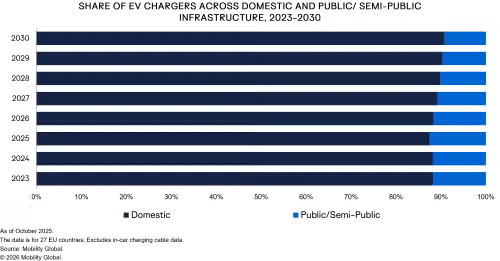
- Accelerate smart charging. Since most EV charging is expected to occur at homes and workplaces, the expansion of private and semi-public charging solutions will increasingly complement the growing public network. Europe now appears well positioned to shift policy and investment toward smart charging, time-of-use tariffs, workplace charging and vehicle-to-grid (V2G) technologies. Together, these innovations represent the next layer of value creation, turning EVs into flexible grid assets rather than simply sources of charging demand. Mobility Global forecasts that total public and semi-public AC and DC charger installations for 27 EU countries (excluding in-car charging cable data) will grow at a compound annual growth rate (CAGR) of about 19% from 2023 to 2030. We expect domestic charger installations to grow even faster, at a 23.33% CAGR, reflecting rapid EV adoption.
- Create a global model. The EU’s use of legally binding, fleet-based EV charging infrastructure targets offers a policy model that other regions can adapt as they expand their own charging networks. Europe’s CPOs, hardware vendors and grid software providers that have scaled under AFIR are also well positioned to export both technology and regulatory expertise as EV markets expand elsewhere.
- Improve profitability. With EV charging infrastructure no longer the primary constraint in much of Western Europe, the industry’s focus can shift from network expansion to improving pricing, roaming interoperability and charging site economics. The lessons learned could help shape the business models that make charging networks both sustainable and profitable.
The road ahead for Europe’s EV charging infrastructure
Europe has largely solved the challenge of building a robust public EV charging network. The next phase will be about making that network more efficient and more profitable. Grid connection delays and the high cost of battery energy storage systems could slow deployment in some markets, while many charging sites have yet to reach utilization levels that support strong profitability.
At the same time, the industry’s focus is shifting toward customer experience. Pricing transparency, roaming interoperability, seamless payments and software integration will increasingly differentiate charging networks. Maintaining stable policy support and resilient supply chains will also be essential to sustaining investment as the market evolves.
The success of Europe’s EV charging buildout has shifted the conversation from whether the infrastructure will exist to how it can deliver the greatest value. If policymakers and the automotive industry can address the next generation of operational and commercial challenges, the region’s early investment could become a lasting competitive advantage.